

#Paraguay: LGBTI Pride Parade for diverse families and against discrimination
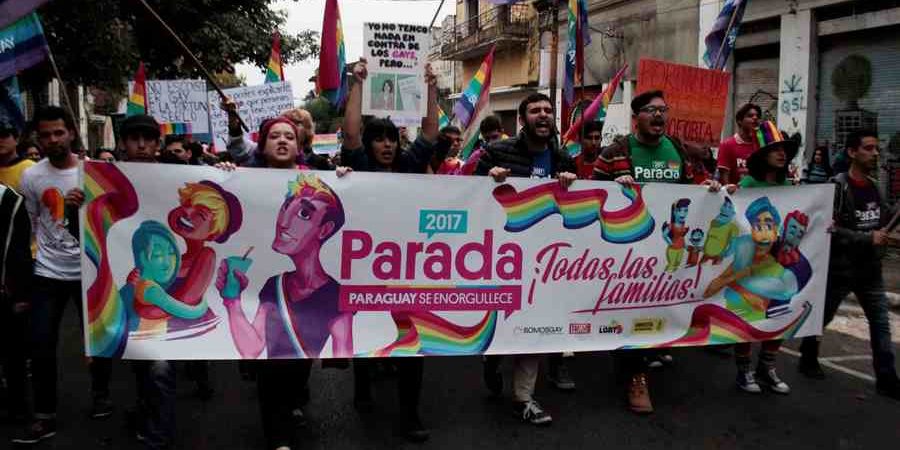
Nearly 500 people—mostly young people and teenagers—participated in the LGBTI Pride Parade in Asunción. As part of the international LGBTI Pride celebrations around the world, this year's theme was diverse families. "The discourse of 'family' is currently hijacked by a very vocal minority of anti-rights people who do not recognize diversity."

Share

Nearly 500 people—mostly young people and teenagers—participated in the LGBTI Pride Parade in Asunción. As part of the international LGBTI Pride celebrations, this year's theme was diverse families. "The discourse of 'family' is currently hijacked by a very vocal minority of anti-rights people who do not recognize diversity," said María Sanz, reporting from Asunción. In a festive atmosphere, to the rhythm of batucada drums and waving rainbow flags, nearly 500 people marched this Saturday from Plaza de la Libertad in the historic center of Asunción to demand equal rights, an end to discrimination, respect for all types of families, and the freedom for LGBTI people to be visible and express affection in public. The Parade was organized by the organizations Somosgay and Lesvos.
 "I've come to support my gay brother"
Most of the march participants were teenagers and young adults, who arrived in pairs or with friends, although some people also came with their families. Among them was Sandra Ortiz. She came to support her brother. “I came to support my gay brother because gay people face a lot of discrimination here. They are rejected in supermarkets, in churches, in health centers. I want them to be seen as normal people, who can dress however they want and go into any place, just like I can,” she told Present.

 There were plenty of signs demanding marriage equality, which Paraguayan law does not recognize. The chants also included remembrances of... UshaA popular Paraguayan transvestite, she became known as a theatrical artist but also as an icon in the fight for the rights of transgender and transsexual people. She died in 2015 of cardiac arrest.
Diverse families but without rights
Families were the focus of the call for this march, as explained to Present Simón Cazal, executive director of Somosgay, said, “We’ve adopted the motto of diverse families because the discourse of ‘family’ is currently hijacked by a very vocal minority of anti-rights people who don’t recognize diversity. Beyond demanding marriage equality for all, we want to include a broader sector of society whose family model lacks legal protection.” He added that, just as same-sex couples don’t have their unions recognized in Paraguay, neither do single-parent or extended families have access to the same rights and protections as nuclear families composed of a father, mother, and children. “We’re trying to break with the idea that family is only what exists in the minds of Catholic leaders or evangelical pastors, and bring it down to earth in Paraguay, where families are diverse and extended, but today they find themselves without rights,” Cazal explained.
"This has an impact on the mental health of LGBTI children and adolescents."
Currently, LGBTQ+ couples in Paraguay, unable to register as civil unions or cohabiting couples, are denied a total of 37 rights that heterosexual couples enjoy, according to Cazal. These include access to loans, first-time homeownership programs, public health services, and social security. Furthermore, LGBTQ+ families are “made invisible in public discourse,” which only considers the traditional nuclear family. “This has an impact on the mental health of LGBTQ+ children and adolescents who, at a crucial moment in their lives, do not see their affection represented in public culture,” Cazal said.
"Homophobia is denied in Paraguay"
She also noted that in Paraguay there is no recognition or protection of individual rights such as the right to identity or the right to free expression of gender, which are systematically denied to transgender people. There is also no protection against discrimination against LGBTQ+ people.[READ MORE: "Paraguay assumed an active role against LGBTI rights at the OAS General Assembly"]
“Paraguay is immersed in a culture of great regression, in which the existence of homophobia is denied. Or the problem of violence against LGBTI people is made invisible,” Cazal stated.
Double discrimination: women and lesbians
Discrimination against the LGBTI community was another of the march's demands, a discrimination that is directed with greater violence against lesbian women, according to what was said to Present Mónica Encina, president of the organization Lesvos. “In a society as patriarchal as Paraguay, with a conservative culture that still dictates that women should be inside the home, we suffer double discrimination: for being women, and for being lesbians“,” Encina said. According to Encina, double discrimination manifests itself “in school, university, and the workplace,” and lately there have been “many complaints” from lesbian couples who are reprimanded or expelled from bars and nightclubs. Encina believes that while Asunción has a gay nightlife scene, there are very few lesbian spaces, which she attributes to the lack of visibility of lesbian women. “Because of this machismo, because of this discrimination, it’s very difficult for us to come out. Even today, lesbians are still seen as sexual objects for men to look at and enjoy,” she said.

"They need to stop seeing us as monsters or sex objects."
She also spoke out against the objectification of bodies and discrimination in nightclubs. Present Drag queen LexxyQuinn. This makeup artist created her character three years ago, but this was her first time participating in the march. “More than once, going to parties in drag, I’ve been banned from entering places. My fight is for normalization, so they stop seeing us as monsters or sex objects. It’s horrible: here, any female figure is associated with something that serves for sex,” she said.[READ MORE: This is how Paraguay celebrates LGBTI memory and resistance]
She attended the march to “claim queer rights and the rights of people who want to explore femininity to express art or feelings.” The march concluded back in Liberty Square with concerts by several local bands. They, too, joined the call for diversity and equality.

We are present
We are committed to journalism that delves into the territories and conducts thorough investigations, combined with new technologies and narrative formats. We want the protagonists, their stories, and their struggles to be present.
SUPPORT US

FOLLOW US
Related notes


We are present
This and other stories are not usually on the media agenda. Together we can bring them to light.