

#Pride2017: This is how Paraguay celebrates LGBTI memory and resistance
Paraguay has its own National LGBTI Rights Day. It commemorates a letter/manifesto that launched the public struggle for sexual diversity. It was during the dictatorship and 10 years before Stonewall. The LGBTI Coalition joined Pride 2017, organizing a Pride march from the Antequera steps with music and performances. It will take place in September.

Share

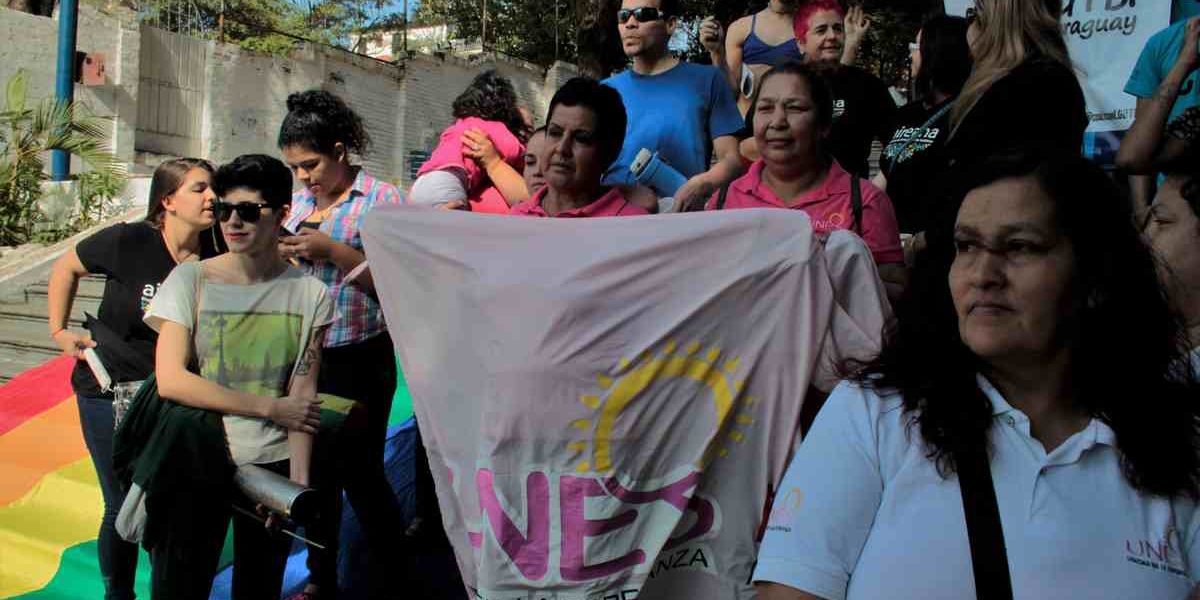
Paraguay has its own National LGBTI Rights Day. It commemorates a letter/manifesto that launched the public struggle for sexual diversity. It was during the dictatorship and 10 years before Stonewall. The LGBTI Coalition joined Pride 2017, calling for participation in the Pride march in September from the Antequera steps with music and performances. By María Sanz, from Asunción. Organizations from the LGBTI Coalition met on International Pride Day 2017 in Asunción to celebrate the memories and resistance of the community at the 14th LGBTI March. In Paraguay, the main day of advocacy for sexual diversity organizations is celebrated on September 30, National LGBTI Rights Day. Yesterday, an event was held at an emblematic location, the Antequera steps, and a call was made to march in September. LGBTI Rights Day commemorates the publication of an anonymous letter in the newspaper El País . Titled " Letter from an Immoral Man," it was the first recorded public written statement in support of LGBTI rights in Paraguay. It occurred ten years before the Stonewall riots, which were commemorated worldwide yesterday. In Paraguay, Pride 2017 was marked by the unfurling of a replica of that letter and a rainbow flag on the Antequera Steps. The percussion group La Tatucada, from Aireana—a lesbian rights organization—provided music for the gathering. Brazilian artist Stelio Barboza also performed a piece, commemorating the death of Bernardo Aranda. And she numbered the steps of the staircase up to 108. Carolina Robledo, an activist with Aireana, explained to Presentes that the LGBTI Coalition recognizes June 28 as an international day of recognition. She acknowledges that the modern LGBTI rights movement was born in the United States. “But Paraguayan organizations recognize September 30 as our own date, commemorating the first public appearance, made anonymously, defending homosexual people, who were persecuted by the police during the dictatorship,” she explained. A reproduction of the Letter of an Amoral Man, the first public demonstration in defense of LGBTI rights recorded in Paraguay, reads:
“ We follow a vocation as old as humanity itself, and in this century of the consecration of all human rights, no one can deny us the right to do with ourselves, with our physical body, what we want, without inconveniencing others who do not wish to do the same as us.”
A reproduction of the Letter of an Amoral Man, the first public demonstration in defense of LGBTI rights recorded in Paraguay, reads:
“ We follow a vocation as old as humanity itself, and in this century of the consecration of all human rights, no one can deny us the right to do with ourselves, with our physical body, what we want, without inconveniencing others who do not wish to do the same as us.”
108 suspects for being homosexual
The “Letter from an Immoral Man” was published just one month after the radio host was found on September 1. Bernardo Aranda He was found burned alive in his bed. His death was “officially” attributed to “a settling of scores between homosexuals.” This sparked a violent crackdown and arbitrary arrests of the LGBTQ+ community throughout that month. In one of these mass raids, more than a hundred people “suspected of being homosexual” were arrested. A total of 108, according to the press at the time. Number 108 It spread rapidly among the satirical press of the time, and even today it continues to be associated with homosexuality in Paraguay.
The staircase that commemorates the struggle
In addition to commemorating a landmark date in the history of the LGBTI movement in Paraguay, the march begins at the Antequera Steps in the historic center of Asunción. This is a symbolic location for the struggle of trans women in Paraguay. “It was in this place that, in the mid-1980s, trans women put their bodies, their names, and their faces on the line and defied the dictatorial regime,” Erwing Augsten Szokol, an activist and researcher on LGBTI historical memory in Paraguay, explained to Presentes. “It was a workplace, where women without any access to education, healthcare, or other employment were forced to be here, in a place where they didn't experience as much violence. Because it was an area known for sex work. In this place, the women began to establish their territory,” Augsten said. Stelio Constantino Barboza performed a tribute to Bernardo Aranda on the Antequera steps.
In 1982, after the kidnapping and murder of teenager Mario PalmieriAugsten recalled that police carried out mass arrests of LGBTQ+ people, including trans women who worked in the Escalinata area. As in the case of Bernardo Aranda, the police accused everyone “suspected of being homosexual” of participating in the crime. Three years later, in 1985, nearly 40 trans women were arrested in the Escalinata area in connection with the death of Alfredo “Freddy” Machain, a well-known hairdresser in Asunción. “In the late 1980s, there was a period when repression against the LGBTQ+ community intensified under the decaying dictatorship, which reacted violently,” Augsten stated. Cases like those of Palmieri or Machain, or like that of Aranda, served as an excuse for the State apparatus during the dictatorship to deploy "illegitimate violence" against LGBTI people, particularly against gay men and the most visible trans people.
Stelio Constantino Barboza performed a tribute to Bernardo Aranda on the Antequera steps.
In 1982, after the kidnapping and murder of teenager Mario PalmieriAugsten recalled that police carried out mass arrests of LGBTQ+ people, including trans women who worked in the Escalinata area. As in the case of Bernardo Aranda, the police accused everyone “suspected of being homosexual” of participating in the crime. Three years later, in 1985, nearly 40 trans women were arrested in the Escalinata area in connection with the death of Alfredo “Freddy” Machain, a well-known hairdresser in Asunción. “In the late 1980s, there was a period when repression against the LGBTQ+ community intensified under the decaying dictatorship, which reacted violently,” Augsten stated. Cases like those of Palmieri or Machain, or like that of Aranda, served as an excuse for the State apparatus during the dictatorship to deploy "illegitimate violence" against LGBTI people, particularly against gay men and the most visible trans people.
“LGBTI people are not treated as citizens.”
“But the dictatorship for LGBTQ+ people didn't end on February 3, 1989 (the date Stroessner was overthrown in a coup),” Augsten warns. “The dictatorship continues in the sense that LGBTQ+ people are not considered citizens, we are not afforded protection by the State, which eliminates everything related to gender from its policies. In these times of resurgent neo-Stroessner rhetoric, homophobia and intolerance are felt more acutely than ever,” he declared. Among these instances of state-sanctioned homophobia, Augsten says that the police try to intimidate same-sex couples who show affection in public, especially in downtown Asunción. He says that on these occasions, the police act arrogantly and try to degrade people, or demand bribes. Stelio Constantino Barboza intervenes on the steps of the Antequera staircase with numbers from 1 to 108. [/caption]
Without legislative tools against discrimination
Carolina Robledo said there are cases of people being expelled from public places or schools for being LGBTQ+. “These situations are becoming visible, and action is being taken.” protests against those places, but there is no legislative tool we can use against discrimination. We are not talking about privileges, but about basic issues, such as the rights to education, health, or decent housing.”The LGBTI Coalition
The Paraguayan LGBTI Coalition is made up of the following organizations: Aireana (a lesbian rights group), Panambí (dedicated to defending the rights of transgender, transsexual, and transvestite people), Las Ramonas (a feminist group), Unidos por el Arco Iris (families and sexual diversity), Escalando (trans people), Mansión 108 (an alternative LGBTI cultural center), Todo Mejora Paraguay (the Paraguayan section of the international NGO It Gets Better), Somos Pytyvohara (peer-to-peer sex education), Paragay (LGBTI), Unidas en la Esperanza (sex workers), CIES Ñepyru (a center for research and sex education), Fundación Vencer (working with people living with HIV/AIDS), and independent activists.
PRIDE WEEK 2017 AGENDA
 ]]>
]]>
We are present
We are committed to journalism that delves into the territories and conducts thorough investigations, combined with new technologies and narrative formats. We want the protagonists, their stories, and their struggles to be present.
SUPPORT US

FOLLOW US
Related notes



We are present
This and other stories are not usually on the media agenda. Together we can bring them to light.