

Transgender employment quota: Rosario selected five workers
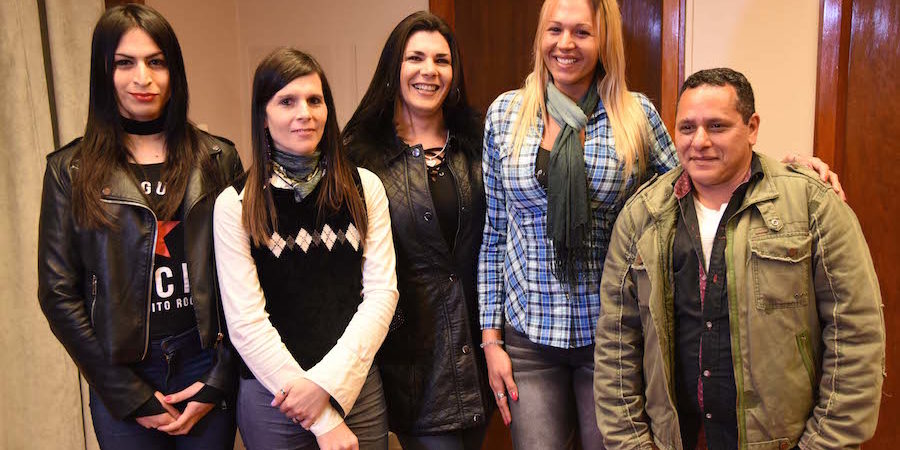
Sixty-two people had applied, and five were selected to work at the Municipality. They were notified yesterday, and this morning the decree was made official with the signature of Mayor Mónica Fein. Presentes spoke with the protagonists on an International Pride Day that will mark history in Rosario.

Share

Sixty-two people had applied, and five were selected to work at the Municipality. They were notified yesterday, and this morning the decree was made official with the signature of Mayor Mónica Fein. Presentes spoke with the protagonists on an International Pride Day that will mark history in Rosario. By Laura Hintze, from Rosario. Photo: Rosario Municipality Press Office. “It’s all very moving, but I have so many things on my mind,” Sabrina Crespo tells Presentes. She sounds overwhelmed, although she emphasizes: “But the first thing was feeling happy.” Sabrina is 32 years old and is one of the five people hired by the Rosario municipal staff through the Trans Employment Quota. The feelings are repeated by each new employee of the Municipality: shock, happiness, and, more than ever today, pride. Daniela Ottone, Alejandro Burgos, Ariana Osuna, and Paula León complete the list of those selected for permanent positions, publicly announced this morning. The news was accompanied by Mayor Mónica Fein signing the decrees that officially recognize the five new members. Rosario has reason to celebrate on International Pride Day.
[READ ALSO: Transgender job quota in Rosario: registration closed and 62 people signed up ]
In May 2016, Rosario became the first city in Argentina to implement a Transgender Employment Quota. The ordinance was approved with the affirmative vote of the entire political spectrum represented on the City Council, with the exception of the Unión PRO Federal bloc, which abstained. The project almost languished, but LGBTQ+ organizations wouldn't let it rest for a second. The Quota was born from sheer activism, and its implementation was equally hard-fought. Between January 23 and March 10 of this year, the Sexual Diversity Area, under the Secretariat of Social Development, registered 46 transgender women and 16 transgender men in the Single Registry of Applicants for transvestite, transsexual, and transgender people. The pre-selection and selection process lasted three months. Pride Day in Rosario was a day of endless celebrations.New steps that dignify identities
Sabrina Crespo's life changed yesterday after receiving a call informing her that she would be starting a new job as an administrative assistant in the municipality's Diversity Department in the coming days. The first thing she did was call her mother and grandmother. "To think that we're part of a historic event. We're the first," she sighs. For her, the secure and stable job is "an opportunity that can't be missed." "It's not easy for anyone to find a job, and it's even harder for us, because discrimination still exists. Employment is much more limited because of sexual orientation, which has nothing to do with our performance in society, in life."[READ ALSO: The trans job quota incorporated the first trans worker in the country in Venado Tuerto ]
Sabrina's first jobs were related to family connections: her aunt's business, her father's. Meanwhile, she tried different fields of study. First economics and advertising, then gastronomy, which is where she got a job offer. "I was lucky, well, I don't know. But yes, the fact that they noticed me, because of my background and how people look at you, is important," she reflects now. The young woman spent years working for herself, hustling, making meals, accepting help from her family. "I never dared to send out a resume. I always thought, what's the point? I think I would feel bad, that it would bring me down. I was convinced the answer would be negative."A job with meaning
Daniela Ottone remembers the times she handed out her resume and had it torn up in her face. All the jobs she's had in her 28 years have been through connections: cashier at nightclubs, a small farm, administrative work. When the quota for transgender people was created, she didn't hesitate to apply. And two days ago, she found out she's going to be an administrative employee in the gender violence department. Daniela maintains that for her, the important thing has always been having a job, no matter how or what it is, as long as it provides benefits, health insurance, and a monthly salary. "And this makes me very happy. Because the place where I'm going to work is rewarding: what better way to also help others than here?" she emphasizes. "I've been working since I was 13. Doing whatever it takes," says Alejandro Burgos. “But as the years went by, everything got more complicated. On the one hand, because they asked me for proof of my education. But then there's the issue of my life choices. More than once, I submitted my resume, which included my birth certificate. They would look at me, then at the document, and their expression would change. The response was always, 'We're looking into it, we'll call you later.' They say it like that out of politeness, but you can tell when there's rejection. They never contacted me.”[READ ALSO: Transgender employment quota approved in Río Grande, Tierra del Fuego ]
Alejandro is 47 years old and has four daughters, aged between 13 and 24. He lives with three of them and his granddaughter, who is one year and five months old. When he applied for the position, he knew it was a good opportunity for him and his family. Alejandro is finishing high school at night and will be working as a clerk for the Municipality of Rosario. When he found out he had been selected, he admits he was in shock. “It’s a lot, a lot. I’m overwhelmed. I don’t like to get carried away. Decent work is a right for everyone. Our life choices don’t limit our ability to work.”“A way to celebrate a historic struggle”
Ariana Osuna dreams of one day working in the Municipal Department of Culture. The 27-year-old is about to graduate with a degree in Fine Arts and has been selected to work as a social worker in the Diversity Area. This will be one of her first jobs. Ariana is from Misiones and arrived in Rosario at the age of 20. For her, this moment is filled with hope and happiness, the possibility of beginning to realize all her dreams. “It’s a present that finds me very joyful. And a way to celebrate a historic struggle, while also not forgetting those other people who, perhaps in the present and past, have had a hostile life, marked by hardship. We mustn’t forget that our identity is always on the brink of death. The good thing about this is that we are being given dignity.”[READ ALSO: #Argentina: progress and shortcomings of the trans employment quota ]
Paula León is the oldest of those selected. She is 45 years old, an age that exceeds the average life expectancy for transgender people by a decade. She never thought the opportunity for formal employment would come her way. Paula only needs to complete about six more courses to graduate as an industrial engineer. “I didn't finish because I was young and all this was up in the air. My situation wasn't very open. I came out of the closet a little late.” The woman recalls that at 20 she “started doing her own thing,” but always in secret. She even remembers that when she decided to move to Buenos Aires, she continued working as “him.” When she finished her work hours, Paula would appear too. Paula's work history includes countless jobs, almost all in restaurants. The possibility of working for the Municipality is something new. “I have an education, I'm qualified, and through this, they're giving me the opportunity to contribute something.” The woman will work in the Production Secretariat in the employment department. The enthusiasm for the new life that begins tomorrow is palpable even over the phone. She also lists the benefits she never had: social security, retirement, stability. Who wouldn't like that? It's only just sinking in now. I'm 45 years old and I have all the experience of the streets. I never imagined this.”We are present
We are committed to journalism that delves into the territories and conducts thorough investigations, combined with new technologies and narrative formats. We want the protagonists, their stories, and their struggles to be present.
SUPPORT US

FOLLOW US
Related notes
We are present
This and other stories are not usually on the media agenda. Together we can bring them to light.