

“Paraguay assumed an active role against LGBTI rights at the OAS General Assembly”
At the 47th General Assembly of the Organization of American States (OAS)—which concluded yesterday in Cancún, Mexico—the Paraguayan foreign minister objected to a section of a resolution against violence and discrimination based on sexual orientation, gender identity, and gender expression. Paraguayan LGBTI organizations believe that the Paraguayan government is leading an increasingly open and belligerent anti-rights stance in the region.

Share

At the 47th General Assembly of the Organization of American States (OAS)—which concluded yesterday in Cancún, Mexico—the Paraguayan Foreign Minister objected to a section of a resolution against violence and discrimination based on sexual orientation, gender identity, and gender expression. Paraguayan LGBTI organizations believe that their government is leading an increasingly open and belligerent anti-rights stance in the region. By María Sanz Domínguez, from Asunción.
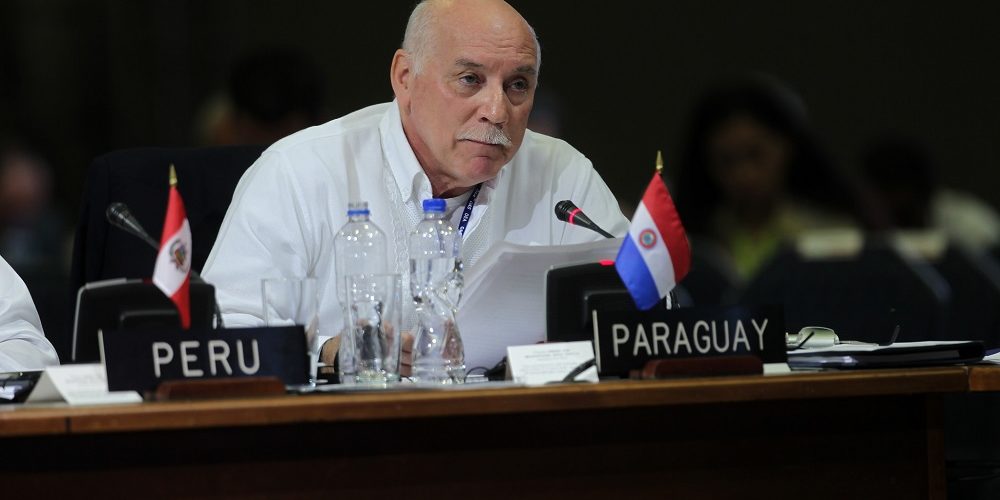
Photos: OAS/Juan Manuel Herrera and Alberto Viveros/Mexican Foreign Ministry. During the 47th General Assembly of the Organization of American States , which concluded yesterday in Cancún, Mexico, representatives of 34 member states approved, after debate, a resolution on the protection of human rights . The draft included measures to protect the rights of people with disabilities, refugees, prisoners, Afro-descendants, journalists, and LGBTI people, among other groups. The article on the rights of LGBTI people was the most controversial for some countries, such as Paraguay. The text proposed “condemning all forms of discrimination and acts of violence based on sexual orientation, gender identity or expression, and intersex characteristics,” and called for the adoption of corresponding public policies. However, the Paraguayan delegation, led by Foreign Minister Eladio Loizaga, proposed its exclusion. They also suggested changing the wording. Paraguayan LGBTI organizations consider this stance by the government a setback. Eladio Loizaga, Paraguay's Foreign Minister, at the OAS General Assembly, Mexico 2017. Representatives from Jamaica, Saint Lucia, and Suriname requested that the point on LGBTI rights be removed from the general resolution. Ultimately, the text was approved despite these objections.
“Paraguay leads a regional stance against LGBTI rights”
“Paraguay is leading a regional stance against LGBTI rights, with the support of Caribbean countries that criminalize homosexuality.”he said Present Activist Rosa Posa Guinea, from Aireana, the lesbian rights organization. Aireana participated in the OAS summit in Mexico through activist Camila Zabala. Yren Rotela represented Paraguay in the Latin American and Caribbean Trans People's Network (RedlactransRotela, who was also at the OAS assembly, appreciated that the proposed text of the resolution was maintained, but considers the Paraguayan government's stance worrying. "When there is a refusal to accept the rights of LGBTI people, as in the case of Paraguay, it is very important to talk with the delegations of the countries and see if they can change their position," she said. The resolution adopted by the OAS calls for the elimination of barriers faced by LGBTI people to participation in political life and for preventing interference in their private lives. It recommends investigating acts of homophobic and transphobic violence and ensuring that victims receive due judicial protection under conditions of equality. It urges the protection of human rights defenders working for LGBTI rights, as well as intersex people, and guarantees them access to medical practices compatible with human rights. Paraguay specifically requested the omission of any mention of intersex people. Furthermore, it suggested that the words “sexual orientation, gender identity and expression” be replaced with “equality and non-discrimination” to avoid the word “gender”—as it already did in 2016. remove this term of the comprehensive law on protection against violence against women. She also asked to include in this section a paragraph reaffirming: “each country has the sovereign right to apply its national laws taking into account its priorities and development plans.”
“An attack against the advancement of rights and freedoms.”
The GayLatino network, which includes the Paraguayan organization Somosgay, denounced through a statement: “In the last few hours, a group of fundamentalist congressmen from various Latin American countries stormed the General Assembly of the Organization of American States (OAS), staging an unprecedented attack against the advancement of fundamental rights and freedoms promoted by this continental organization.” The GayLatino network emphasized that these conservative groups speak of imposing “policies and ideological perspectives that threaten the right to life, family, and freedoms of expression, association, and religion.” “But andsThese types of statements only incite gender-based violencesexual orientation and gender identity and/or expression, in the region of the world with the highest number of hate crimes.” The network also points out that this onslaught is occurring in a context where “has Discrimination against lesbians, gays, bisexuals, trans and intersex people has intensified in the Americas.” Therefore, he urges to the Governments of the countries included in the OAS Assembly “to consolidate the progress made in recent years"and to assume the firm commitment to continue working towards a hemisphere without criminalization of consensual same-sex relationships and with full recognition of trans identities."
[READ MORE: Trans people in Paraguay have doubled their reports of violence ]
Why Paraguay avoids commitments at the OAS
From Aireana, Rosa Posa pointed out that resolutions from international organizations do not necessarily govern the public policies of states. They are more of a “declaration of intent.” However, in countries like Paraguay, where domestic legislation is not favorable to LGBTQ+ rights, people can resort to these international norms signed by the country to claim their rights, the activist explained. That is why Paraguay wants to avoid making these commitments.
Rights in decline since 2014
Posa added that the Paraguayan government's opposition to LGBTI rights has been intensifying since June 2014. At that time, also at an OAS General Assembly held in Asunción, Paraguay avoided signing a statement condemning acts of violence against LGBTI people. The decision prompted protests from several LGBTI organizations, who demonstrated near the venue where the Assembly took place, and They were violently repressed.Insults, threats and persecution of LGBTI activists
The OAS resolution also mentions acts of persecution against LGBTI rights defenders. Posa believes that, although there is no “open war” against LGBTI activists in Paraguay so far, they are “in the crosshairs.” She even recalls that, in 2016, her photograph appeared on the front page of a tabloid newspaper. Chronicle, as alleged instigator of a student protestPosa wasn't even in the country at the time. Meanwhile, the journalist Karen OvandoA radio announcer on Radio Urbana told Presentes that she is increasingly receiving lesbophobic insults and threats on social media. “I recently reported something that happened a couple of years ago, when a group of men on Facebook were joking about me, and even talking about raping me to ‘correct’ my sexual orientation,” she recounts. She says the justice system neither investigated her case nor provided her with judicial protection, two of the recommendations included in the OAS resolution. “I took the entire conversation to the Prosecutor’s Office to have a record in case something happened to me. But the Prosecutor’s Office didn’t take my case, because they said they couldn’t take ‘jokes’ seriously. On the contrary, one of the people I reported sued me and an NGO that echoed my complaint—the organization Tedic—and They forced us to delete it.“Ovando stated. Data from reports by Panambí, an organization that defends the rights of transgender people, also speak of violence, discrimination, and a lack of judicial investigation into cases of transphobic murder, which total nearly 60 since 1989—all of them unsolved. In 2016, a total of 87 complaints of violence and discrimination based on sexual orientation or gender identity against transgender people were registered in Paraguay, according to [source missing]. Panambi's annual report.[READ MORE: Paraguay: Trans women excluded from comprehensive protection law ]
The governments of American countries, including Chile, Cuba, Argentina, and Colombia, asked Paraguay in early 2016 to adopt measures to prevent discrimination based on sexual orientation and gender identity, during the Universal Periodic Review on Human Rights to which the country submitted. To date, Paraguay is one of the few countries in the region that does not have laws against all forms of discrimination. A bill on this subject It was rejected at the end of 2014 in Parliament, amid fears from conservative lawmakers that the law would enable same-sex marriage. New members of the IACHR Yesterday, at the final plenary session of the OAS meeting, the new members of the Inter-American Commission on Human Rights (IACHR) were elected. The new members will be Joel Hernández (Mexico), Flávia Cristina Piovesan (Brazil), and Antonia Urrejola (Chile).We are present
We are committed to journalism that delves into the territories and conducts thorough investigations, combined with new technologies and narrative formats. We want the protagonists, their stories, and their struggles to be present.
SUPPORT US

FOLLOW US
Related notes


We are present
This and other stories are not usually on the media agenda. Together we can bring them to light.
1 Comment