

Namuel: Chile's pop promise who defies homophobia
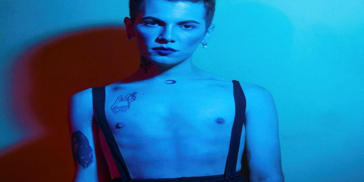
At just 24 years old, Chilean Manuel Granic, "Namuel," was Javiera Mena's keyboardist and two years ago burst onto the scene as a solo artist, becoming an iTunes and YouTube star. A representative of a generation that champions LGBT visibility, his lyrics draw from his own life, and he's now preparing a second album with a strong political message. We asked him #5Questions.

Share

At just 24 years old, Chilean Manuel Granic, “Namuel,” was Javiera Mena’s keyboardist and two years ago burst onto the scene as a solo artist, becoming an iTunes and YouTube star. A representative of a generation that champions LGBT visibility, his lyrics stem from his own life story, and he is now preparing a second album with a strong political message. We asked him #5Questions. By Ulises Rojas. Singer and keyboardist Manuel Granic, better known as Namuel, rose to fame after the release of his album “Folclórico.” He was only 22 years old, and with songs like “Las medallas” and “Lucha libre,” he openly addressed queer experiences. At the end of last year, “Maldita Ingenuidad” was released as his single, crossing the Andes to make him known throughout Latin America and the world. Unafraid of being labeled “queer” in a Chilean society deeply marked by homophobia, he is currently promoting his new single “Yugoslavia,” which already has a music video. In this interview, she talks about her art, her musical influences, and her experiences in a country where sexual minorities are still endangered. "That's why visibility is important to me. So that people realize we exist and that we are valid people," she says in this interview.
– What changes did you notice after the release of “Folclórico”?
– That's when I started to take off in terms of playing live. Every week I was invited to parties to do live "interventions" and things like that. I also assume that people finally put a face to my music, since I had hardly ever performed live and didn't have any videos.
– How important is visibility in your work?
– It's one of the most important things for me, along with using art as a method of escape and catharsis. In fact, I'm always being asked why I don't aim for a "more mainstream" (heterosexual) audience or if I enjoy this niche art thing. But it's not a conscious effort; I'm just representing myself. In the end, everything I do is autobiographical and genuine. I think I'm too old to create a persona and try to please a heterosexual audience. They already have all the mainstream media; I'm really over them.– Who are your role models in music and in life?
– In music, I have countless influences! I grew up listening to Shakira's "Greatest Hits" CD until it fell apart, and I still remember all her lyrics religiously to this day. Adolescence and that whole search for my own identity led me to discover many musical styles and icons, like Dolly Parton, Cyndi Lauper, Nina Simone, Björk, etc. Lately, I've been really inspired by a rapper called Cupcakke who started out reading poetry in church and is now famous for rapping about her vagina. Idol. I love her. How did the leap to mainstream success happen? – I don't know. I don't feel like I'm part of a mainstream movement. But I do get really excited every time someone I don't know draws me a picture or sends me a SpongeBob meme. It's the little things. In Chile, at least for me, it's difficult. There isn't a day that goes by without me being insulted at least once in the street. Always shouts from cars, trucks. And that's the "best" luck. The worst is when a group of homophobes finds you alone in the street and does something to you. It hasn't happened to me, but it has to my friends. It's a very real and very close danger. That's why visibility is important to me. So that people realize that we exist and that we are valid people. In the media, you don't exist. If you deviate from the "norm," you don't sell and you don't exist, in a mainstream sense. There's nothing the media loves more than a good old sexual, gender, or racial stereotype.We are present
We are committed to journalism that delves into the territories and conducts thorough investigations, combined with new technologies and narrative formats. We want the protagonists, their stories, and their struggles to be present.
SUPPORT US

FOLLOW US
Related notes
We are present
This and other stories are not usually on the media agenda. Together we can bring them to light.