

Bachelet announced marriage equality but omitted the Gender Identity Law
She did so in her final address to the Chilean Congress. Organizations representing sexual diversity and gender identities, along with groups of people living with HIV/AIDS, expressed their discontent with the president's speech. They announced a march for June 24th.

Share

She did so in her final address to the Chilean Congress. Organizations representing sexual diversity and gender identities, along with groups of people living with HIV/AIDS, expressed their discontent with the president's speech. They announced a march for June 24th.
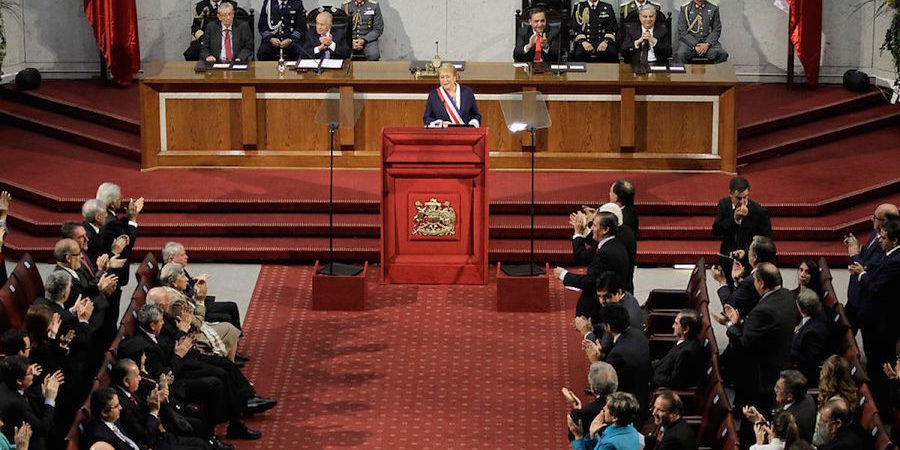
The public address by the President of Chile, Michelle Bachelet Jeria, the last of her term, lasted two hours, during which the socialist leader reviewed her administration and among the most important announcements highlighted the constitutional recognition of indigenous peoples and the submission of a bill for Equal Marriage.
Organizations representing sexual diversity and gender identities, along with groups of people living with HIV/AIDS, expressed discomfort and impatience with Michelle Bachelet's speech.
[READ ALSO: #Chile: Bachelet pledged to pass an equal marriage law ]
“I believe Bachelet didn’t speak out in favor of the Gender Identity Law because it’s a complex and unpopular bill,” Niki Raveau, a trans activist with Fundación Transitar, a group that fights for the rights of trans children and adolescents in Chile, told Presentes . Niki is referring to the president’s controversial silence, which sparked numerous reactions, after she announced the submission of a Marriage Equality Bill to the National Congress.

Most of the members of parliament present at the event applauded the announcement, while the Cardinal Archbishop of Santiago, Ricardo Ezzati, expressed his displeasure with a striking look captured by television cameras. “It’s not the same for something to be legal as it is for it to be ethically good for the country,” Ezzati declared at the close of this report.
Bachelet's commitment to Movilh
From early on June 1, Chilean sexual and gender identity organizations began to make their historical demands visible through social media, expressing their open discontent at the end of Bachelet's speech.
The Movement for Homosexual Liberation and Integration (Movilh) reminded Michelle Bachelet early this morning of an unprecedented international agreement signed with the organization and the Inter-American Court of Human Rights that obliges the State of Chile to advance an agenda of civil and social rights for the Chilean LGBTI community.
In January 2017, the President signed an agreement with Movilh at the La Moneda Palace itself, promising at that time that she would present a bill for Equal Marriage before June 30, 2017.
“Love is stronger”
Michelle Bachelet, visibly moved, while highlighting the expansion of personal freedoms during her second presidential term, announced that "during the second semester we will introduce to this Honorable Congress a bill for Equal Marriage, because it cannot be that old prejudices are stronger than love," she stressed, provoking applause from the public and legislators, but some unease and concern among the sexual diversity organizations present at the event.
"We see this as being much more about a headline and applause than about a real political will on the part of the Government to move forward with marriage reform and a real end to discrimination in access to it," Emilio Maldonado, Executive Director of Fundación Iguales, told the press, adding that Michelle Bachelet had "missed the opportunity to go down in history."

The Movement for Homosexual Integration and Liberation (Movilh) expressed its dismay at the failure to meet deadlines and fulfill public political commitments, announcing a march for the Equal Marriage Law and the Gender Identity Law to be held next Saturday, June 24th at 2:00 PM in Plaza Italia in Santiago.
The aim of the protest action will be "to express rejection of those who oppose the Equal Marriage Law and the Gender Identity Law for homophobic and transphobic reasons," the organization said in a press release.
For their part, trans organizations resented the omission on fundamental issues, particularly the Gender Identity Bill that has been processed for 4 years in the National Congress and which excluded trans children from its processing and inclusion.
[READ ALSO: Selenna, the Chilean trans girl who became a symbol of pride ]
Constanza Valdés, a trans woman and legal advisor for the OTD Chile association, said: “We had the slightest hope that she would mention it, especially considering that it will be voted on in detail this week in the chamber, and it was very important that she call for a vote in favor. Or at least mention it among what they consider their advances, like the trans circular. We find it regrettable,” the activist emphasized, “that only the Civil Union Agreement and Equal Marriage were mentioned.”
“The discussion of the project was not taken to the grassroots level”
Niki Raveau believes that Bachelet's silence is due to a strategy because the actions taken by her government have been aimed at failing the controversial Gender Identity bill.
“They’ve handled it poorly from the start, bringing people who were both for and against the proposal to the table, thus delaying the discussion for more than four years. Sexual diversity organizations need to engage in self-criticism because the project wasn’t discussed at the grassroots level, and no greater community impact was achieved,” he points out.
[READ ALSO: Schools ordered to respect trans identities: “A milestone in school coexistence” ]
Valdés of OTD believes that Bachelet didn't mention the Gender Identity bill "because she knows it's a difficult issue, but also because of a lack of political commitment. It's one thing for her to say she's in favor and supports it, but when it comes to making the situation of trans people visible, she does nothing," she told the press, clearly annoyed.
For his part, Francisco Gutiérrez, president of the Movement for Sexual Diversity (MUMS), states that it is difficult to assess President Bachelet's State of the Nation address when "there are LGBTI organizations that have prioritized same-sex marriage on the political agenda, to the detriment of other important demands." "We would have expected a thorough reform of the Anti-Discrimination Law to be prioritized," Gutiérrez adds, "because that would have been a great gesture for the LGBTI community, which suffers from constant discrimination, persecution, and homophobia."
#ChileWithoutAIDSCampaign
For their part, civil society organizations working in sex education, sexual rights and HIV/AIDS prevention openly criticized the president's lack of a public statement on the pandemic at a time when the number of people affected is steadily increasing, particularly among young people aged 20 to 29.
 In a statement, organizations gathered in the so-called Social Platform for HIV/AIDS and Human Rights pointed out that “despite its recognized public importance and the alarming statistics that indicate a sustained increase in HIV notifications in the younger population, coupled with the absence of sexual education plans in schools, organized civil society continues to await a Social Communication Campaign for HIV/AIDS Prevention from the State of Chile.”
[READ ALSO: #HIV in Chile: lack of public campaigns denounced ]
In the document, the sexual diversity organizations and organizations of people living with HIV/AIDS pointed to the legal obligation to implement the educational and information initiative, denouncing that "the last HIV/AIDS Prevention Campaign of the Ministry of Health was issued in 2015 and that in 2016 there was no HIV/AIDS prevention campaign, while in 2017 we are still waiting."
Marco Ruiz, a long-time activist for sexual diversity and member of the Public Policy Observatory on HIV/AIDS and Human Rights at the Savia Foundation, points out: “The Chilean State is failing the HIV/AIDS movement because, after 30 years, while there was a period of commitment, lately we see that HIV/AIDS is neither a preventive nor a political priority for the government. I believe that when demands are institutionalized, such as access to antiretroviral treatment, the social pressure disappears. We must raise a new banner of struggle from within our communities, promoting active monitoring of public policy for the benefit of new generations who lack the resources to confront the pandemic.”
We are present
We are committed to journalism that delves into the territories and conducts thorough investigations, combined with new technologies and narrative formats. We want the protagonists, their stories, and their struggles to be present.
SUPPORT US

FOLLOW US
Related notes

We are present
This and other stories are not usually on the media agenda. Together we can bring them to light.