

A documentary about the transition of Laerte, Brazil's most famous cartoonist
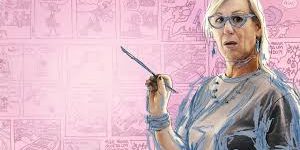
After three children, three marriages, thousands of cartoons, and several awards for her creative work, cartoonist Laerte abandoned the mandate of male identity and transitioned at age 60. A recently released Netflix documentary explores her story from a personal, intimate, and political perspective.

Share

After three children, three marriages, thousands of cartoons, and several awards for her creative work, cartoonist Laerte abandoned the mandate of male identity and transitioned at age 60. A recently released Netflix documentary explores her story from the personal, the intimate, and the political. By Ivana Romero. The first “feminine” clothes she wore were, rather, the ones she took off. She already knew what it was like to wear underwear or a bra: for some time she had dressed as a man during the day and transformed into a queer diva some nights. “What I took off was my hair,” she reveals. And she bursts into a hilarious laugh, the same one that many of her cartoons provoke. Laerte Coutinho recounts that this happened while she was lying on a table, with an epilator applying wax here and there. “My legs! When I saw them without hair, I couldn’t believe it. I was a different person, lighter, invading the feminine world,” she says. But no, things aren't that simple. Lighthearted, yes, but distracted, never. "Men can go out dressed however they want; generally, they don't pay much attention to those things. Women don't, because they're not in their own world: they move in the world of men. So they have to be careful," she explains. And her long, blonde hair floats in the air like an enigma.
The public and the everyday
The personal, the intimate, and the political are three overlapping planes of Laerte Sewhich has just premiered on Netflix. It is a documentary that, with enormous subtlety and empathy, traces a profile of Coutinho, one of the most popular and prestigious graphic humorists in Brazil, who, after three children, three marriages, thousands of cartoons and several awards for her creative work, abandoned the mandate of the masculine and transitioned at sixty years old. Laerte Se The first original Brazilian documentary on the North American streaming service is directed by filmmaker Lygia Barbosa Da Silva and Eliane Brum, who is also a writer and journalist. One filming, the other interviewing, they spent a couple of years accompanying the artist to events such as her 2014 Ocupacao retrospective in São Paulo and her daughter Laila's wedding. But also, in more intimate situations, like the renovations to her house in São Paulo (“it’s a somewhat uncomfortable house, inadequate like me,” she’ll say), the visits to her son Rafael to fix the computer monitor (“I call him ‘Dad’ and my son calls him ‘Grandpa’ because we come from a family with eight grandmothers but no grandfathers, and Laerte said, well, if that’s how it is, he’s fine with it,” he’ll say), or the moment when her grandson asks her to play the Batman theme on the piano. Added to this are the doctor’s appointments while she decides whether or not to get breast implants, her nudity while bathing or shaving her legs, and the way she hugs her cat Selina, trying to answer the question of whether she, Laerte, is a man or a woman.Activism and awards
Born in 1951 in São Paulo, where she still lives, she began publishing her cartoons in the early 1970s. A former member of the Communist Party, and with several friends murdered by the dictatorship, she founded the publishing house Oboré, dedicated to producing materials for labor unions. It was during this time that she met Lula da Silva. She worked for comic magazines such as Circo and Chiclete com Banana, and in the 1990s began publishing in various media outlets, including the newspaper Folha de São Paulo, where she continues to work. In the 1980s, he joined forces with cartoonists Angeli and Glauco, and together they became a legendary trio in the underground scene: Los Três Amigos (The Three Friends). They began publishing a joint comic strip about the story of three musketeers. losersThese comics caricatured personalities and obsessions that, they would admit, they had in real life. “I am Laertón, animalistic, vile, perverted,” his alter ego would say in those comics, where Laerte was drawn as a skinny, bearded mariachi. He won six HQ Mix awards, something like the Brazilian Oscar of comics, and an Angelo Agostini award for “master of national comics.” He also published several books, including three volumes that compile one of his most popular strips, Piratas do Tietê.
Alter-ega
One of her characters, Hugo, started wearing dresses before she did and occasionally transformed into Muriel. “Hugo’s petticoat is always showing because it reveals your desire,” a friend warned her at a time when the cartoonist was researching crossdressing on his own and keeping his homosexuality more or less a secret. Laerte Se It includes several of these vignettes. For example, one where Muriel takes pills to instantly grow breasts. Or another where she sits in the waiting room of a urological clinic, wearing high heels and surrounded by men, saying with absolute poise: “Yes, friends, under this dress is a prostate just like yours.”
Woman, and that's it.
But life hasn't always been easy for her. In 2009, her 22-year-old son, Diogo, passed away. She felt like her world was collapsing. “But I decided I was going to be myself. That is, I was going to be a woman, and I was going to do it publicly,” she says. It was in September 2010, in an interview with Bravo magazine, that Laerte spoke publicly for the first time about her cross-dressing. “Why can't a man embark on a radical journey through the unfathomable world of women?” she wondered at the time. Then came photo shoots where she posed clothed and nude for Rolling Stone and other magazines, something she does again in the documentary to show that gender construction is cultural, not genital. “I once said I was a man exploring the world of women, but now I say I’m a woman, period. And I advocate not only for gender freedom, but also for the inclusion of identities that are neither feminine nor masculine. I’m also bothered by the trans corporatism that tells you that you have to be one way or another. It never occurred to me to cut off my penis; I feel it as a form of castration that would validate what I’m trying to fight against: biologism,” she states.Public voice
Artistic creation as an enigma, the doubts about how to construct a body that ages outside the norm and within the realm of desire, identity as both a construct and a human right—these are also recurring themes in this film. The documentary includes Super 8 footage from the family archives showing her as a child with her father, a professor, and her mother, a biologist, who never fully accepted her female identity. “My mother initially offered me her dresses, but then she told me she was afraid they would hurt me. Luckily, that didn't happen. People tell me I'm brave, but I don't believe it. I finally decided to be this way when my children were grown, when I had a job and a certain reputation. I know that for many trans people, things are more difficult,” says someone who has managed to reinterpret her name, so reminiscent of Greek mythology, so Hamlet-like, to make it her own brand. The political aspect is not overlooked in the film either. Laerte has made public commitments to the LGBTQ+ community and, at the same time, has spoken out in the streets and in her comic strips against Michel Temer's institutional coup. During her daughter's wedding celebration, she draws a picture for the newlyweds. She draws them as fierce and beautiful pirates in the style of Tietê, with the caption "Cadu and Laila: across the seven seas of love." Throughout Laerte SeIt is clear that Laerte also crossed her own seven seas. And she emerged victorious.
We are present
We are committed to journalism that delves into the territories and conducts thorough investigations, combined with new technologies and narrative formats. We want the protagonists, their stories, and their struggles to be present.
SUPPORT US

FOLLOW US
Related notes


We are present
This and other stories are not usually on the media agenda. Together we can bring them to light.