

For the first time, the Inter-American Court requested an opinion on LGBTI rights.
The Inter-American Court of Human Rights (IACHR) invited 43 countries and 91 organizations to submit opinions on LGBTI rights standards. Argentina was represented by Cien por Ciento Diversidad y Derechos (One Hundred Percent Diversity and Rights). Greta Pena, its president, included in her presentation a text by writer Claudia Piñeiro on marriage equality.

Share

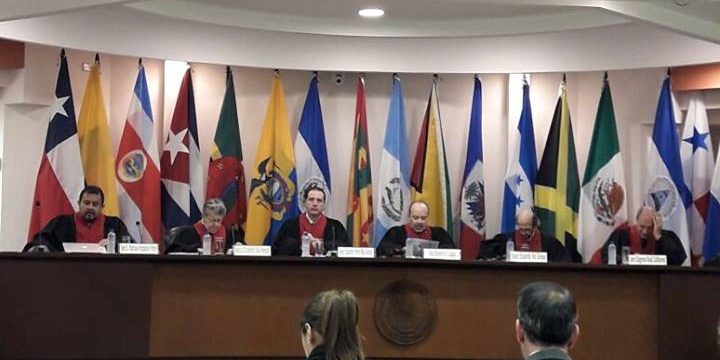
The Inter-American Court of Human Rights (IACHR) convened 43 countries and 91 organizations to submit opinions on LGBTI rights standards. Argentina was represented by Cien por Ciento Diversidad y Derechos (One Hundred Percent Diversity and Rights). Greta Pena, its president, included in her presentation a text by writer Claudia Piñeiro on marriage equality. For the first time in history, the Inter-American Court of Human Rights (IACHR) convened a public hearing for an advisory opinion on the rights of LGBTI people. This followed a request from Costa Rica for interpretation of specific aspects of the rights of gay, lesbian, bisexual, transgender, and intersex people. One of these aspects concerns the protection afforded by the American Convention on Human Rights to the recognition of a person's right to change their name in accordance with their gender identity. Another concerns the protection afforded by that treaty to the recognition of property rights arising from a relationship between people of the same sex.
43 countries at the Inter-American Court of Human Rights
During the hearing, held in Costa Rica and coinciding with the International Day Against Homophobia and Transphobia, the Court received the opinions of 43 state delegations and 91 written observations from representatives of organizations, university members, and individuals. Greta Pena, president of Cien por Ciento Diversidad y Derechos (One Hundred Percent Diversity and Rights), participated on behalf of Argentina."Gender identity cannot be proven"
“In our presentation we made it clear that Gender identity is not subject to proof, but to recognition.“He told Presentes. He explained that the administrative route is the only appropriate one for that request, because There's nothing to prove.There is no need to go to court. “It is a matter of requesting recognition of our identity from the state's administrative registry authority, a name and registration details that correspond to it, and access to our legal personality as a condition for exercising the rest of our rights.” He pointed out that in Argentina, the only instance in which one must resort to the courts is in the case of minors who wish to access reassignment surgeries. “In those processes, the justice system continues to create obstacles, demanding various medical and psychological certificates.” Regarding property rights derived from a relationship between people of the same sex, he said that the normative framework of diversity should be adopted instead of that of difference. And he spoke of not making hierarchical distinctions between sexual orientations. “Because it is about interpretation, about ensuring that the rights protected in international legal instruments remain alive, and understanding that this Honorable Court has the possibility, as it has done on other occasions, to guide States with its opinions and, without owning the words, to give them the contemporary meaning they demand, we choose to share an excerpt from a text by the author Claudia Piñeiro,” Pena read. And she concluded her presentation by reading aloud these words by the writer, playwright, and screenwriter, written during the process of passing the equal marriage law in Argentina.
The text by Claudia Piñeiro read in the Court
Dear Director of the Royal Spanish Academy: I'm writing to you because I believe you must be the right person to answer a question that has become a true obsession for me: Who owns words? Perhaps it seems silly, naive, or pointless to you, but it's an unavoidable question for me. And then other questions arise as well: Can you pay to own a word? Are words seized after a war, an invasion, or even a simple battle? As you know, words name everything that exists, whether tangible like a table or intangible like a dream. But the process is two-way because in naming, words also construct reality. Or they deny it. If someone with enough power were to appropriate the word "house" and only allow three-room dwellings with two bathrooms and a backyard to be referred to as such, all other "houses" would be denied their existence and would have no choice but to be named differently or disappear. What cannot be named with the appropriate word is denied, ignored, and disappears. Ultimately: whoever denies us the use of a word also denies us the existence of what that word names, and if it names us, then whoever appropriated it reduces us to what does not exist. Now, neither I nor anyone else has a problem with the word "house." But imagine if someone were to appropriate the word "love" and define what can and cannot be called that. Or "justice." Or "dignity." Or "flower." Or "normal." Or "healthy." Or "culture." Or "natural." Well, Mr. Editor, in my country, there has been an appropriation of language. Someone believes they own the word "marriage" and can say what is and isn't a marriage. And it's not a legal matter, as they would have us believe. Because laws, Mr. Editor, are a theoretical construct, an agreement among people. Laws, as a theoretical construct of people and their time, are subject to change. Illustration: Florencia Capella
Those who deny it know this better than anyone. That's why the real battle isn't there, but rather over the ownership of the word. The word MARRIAGE is a word in flux today. For a long time, it was enough for it to simply name a man and a woman who decide to legally unite. Not anymore. Words are living things. If I only named that "man-woman" bond, we would be denying the existence of something that exists. If I only named the heterosexual bond, what would I call the years-long bond between my friends Mauro and Andrés, or between my friends María and Vanessa, or between Patricia and Olga? I want that word to name them, because that's what they are. Much more so than other couples who don't want to reconsider the use of the word because what would collapse is the bond they're holding together by a thread. Those who claim ownership of the word MARRIAGE come out and say: "Well, let them be, let them live together if they want, but let them use another name." And what they're proposing isn't naive or merely legalistic; it's ontological. They know that to deny them their voice, to deny them their names, is to deny their very existence. It's a method that comes from concentration camps and clandestine detention centers where people deprived of their freedom were called by a number, where their names were forbidden, because the objective was for them to disappear.
But I know that you, like me, care about words, their use, and the battles fought in their name. I anxiously await your response. I want the opportunity to come face to face with whoever claims to own this word: MARRIAGE. I want to argue with him, I want to fight. For the friends I'm not allowed to name today, but also for myself, for my children, for my children's friends, for the memory of my deceased parents, and for all the other unnamed people our society, the one we all built together, still denies.
Claudia Piñeiro
Illustration: Florencia Capella
Those who deny it know this better than anyone. That's why the real battle isn't there, but rather over the ownership of the word. The word MARRIAGE is a word in flux today. For a long time, it was enough for it to simply name a man and a woman who decide to legally unite. Not anymore. Words are living things. If I only named that "man-woman" bond, we would be denying the existence of something that exists. If I only named the heterosexual bond, what would I call the years-long bond between my friends Mauro and Andrés, or between my friends María and Vanessa, or between Patricia and Olga? I want that word to name them, because that's what they are. Much more so than other couples who don't want to reconsider the use of the word because what would collapse is the bond they're holding together by a thread. Those who claim ownership of the word MARRIAGE come out and say: "Well, let them be, let them live together if they want, but let them use another name." And what they're proposing isn't naive or merely legalistic; it's ontological. They know that to deny them their voice, to deny them their names, is to deny their very existence. It's a method that comes from concentration camps and clandestine detention centers where people deprived of their freedom were called by a number, where their names were forbidden, because the objective was for them to disappear.
But I know that you, like me, care about words, their use, and the battles fought in their name. I anxiously await your response. I want the opportunity to come face to face with whoever claims to own this word: MARRIAGE. I want to argue with him, I want to fight. For the friends I'm not allowed to name today, but also for myself, for my children, for my children's friends, for the memory of my deceased parents, and for all the other unnamed people our society, the one we all built together, still denies.
Claudia Piñeiro
What is the Inter-American Court of Human Rights?
The Inter-American Court of Human Rights (IACHR) is an autonomous judicial body of the Organization of American States (OAS), headquartered in San José, Costa Rica. Its function is to apply and interpret the American Convention on Human Rights and other human rights treaties to which the so-called Inter-American system for the protection of human rights is subject. Advisory Opinions can be requested by any of the member states of the Organization of American States (OAS) and by OAS bodies. “The purpose of the Court’s interpretative work is not only to unravel the meaning, purpose, and rationale of international human rights norms, but also to contribute to the full and effective fulfillment of the international obligations of the American States in this area,” the Court explained in a statement.We are present
We are committed to journalism that delves into the territories and conducts thorough investigations, combined with new technologies and narrative formats. We want the protagonists, their stories, and their struggles to be present.
SUPPORT US

FOLLOW US
Related notes


We are present
This and other stories are not usually on the media agenda. Together we can bring them to light.