

“Neither confused nor in transition: being bisexual is my decision”
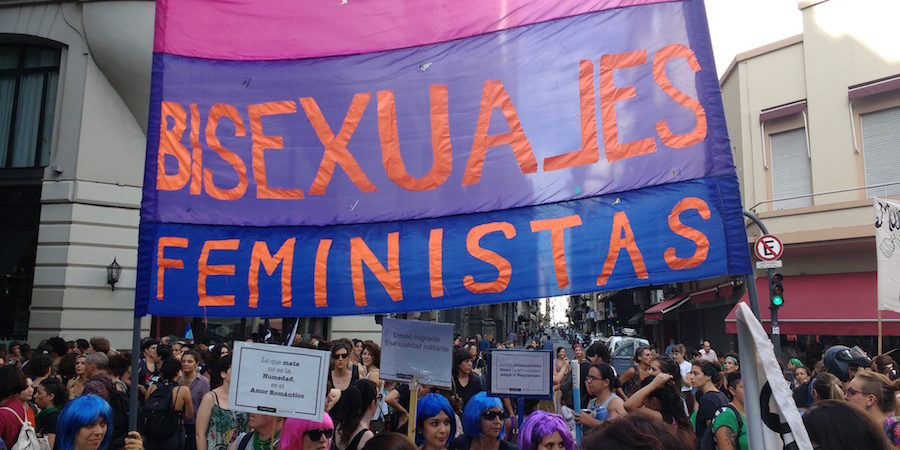
The members of the "Feminist Bisexualities" collective met during the 2011 National Women's Meeting in Bariloche and decided to organize a parallel workshop. By the following year, "Women and Bisexualities" was included in the official workshop program of the Meeting, and that was just the beginning.

Share

The members of the "Feminist Bisexualities" collective met during the 2011 National Women's Meeting in Bariloche and decided to organize a parallel workshop. By the following year, "Women and Bisexualities" was included in the official workshop schedule of the Meeting, and that was just the beginning. To get to know them better, we asked them five questions. By Lucas Gutiérrez. Open to women (cis and trans), the group is growing. In Buenos Aires, Rosario, and Córdoba, there are groups that meet regularly, in addition to constant interaction on social media. Whether to organize activities, share experiences, celebrate, or advocate, the space unites them. "We are growing in number, and we have a lot of enthusiasm, a lot of ideas, and a lot of anger," say the Feminist Bisexuals.
1- What are the political implications of declaring oneself bi?
The personal is political, which is why we think it's important to build and make visible the group of bisexual feminists. Because it's good for us, because we believe that spaces for exchange and reflection are necessary. Because we believe that Sisterhood killed the macho, as our t-shirts say. Identifying as bi implies questioning binary thinking and monosexism.It also involves trying to recover the history of bisexuality as a movement. Because just as there have always been people who identify as lesbian, gay, or trans, there have always been and still are bisexual people.
2- What prejudices do they have to deal with?
Bisexuality is constantly made invisible, and there is a great deal of prejudice and mistreatment towards bi people. People think we're caught between being straight or not, when in reality We are neither straight nor lesbianOur desire is not heterosexual, nor does it depend on the people we are in relationships with; it flows independently of our partner's gender. That's why we don't talk about genitalia either. This invisibility carries enormous weight, especially at certain stages of life. We hear this quite often in our shared experiences and at Women's Gatherings. Accepting that one's own desire is bisexual, when everything around us tells us that this is impossible, involves countless conflicts and contradictions. That's why we believe it's important that Comprehensive Sexuality Education includes alternatives to the heterosexual-homosexual binary, to reflect reality and better support children and adolescents.[READ ALSO: Lesbian and feminist reggaeton: Chocolate Remix takes a turn towards the genre ]
Beyond invisibility, there are also negative stereotypes about bisexuals that portray us as indecisive, unfaithful, treacherous, promiscuous, a source of infections, etc. Some of us may be more outgoing than others, but you can't generalize, nor assume that just because you're outgoing you can't be honest in your relationships. The reality is that we think and reflect a lot about relationships; we seek to establish healthy, loving, and considerate connections. Breaking free from mononormativity is a challenge in this sense, and being able to talk and build new ways of connecting carries a heavy emotional weight. It demands a lot of care and commitment.
3- Is it in the family, medical, work or activist spheres where bisexual people experience the most violence?
– In everyone, although with varying intensity in each experience. Some families adapt better, and some environments are more inclusive and open than others. The reality is that we experience biphobia very closely within the LGBTQ+ movement. It's sad that we experience it precisely with lesbians, who are also the ones with whom we march for Higui's freedom, dance at a Pride march, or get close at a party. We are all part of the same struggles, we are allies. It's ridiculous to think that because we are bisexual, we are just passing through lesbianism while waiting for the sacred arrival of a man. Just as there are misogynists who tell two women together that they haven't tried anything or that they don't know what's good, sometimes we receive the same thing from lesbian sisters, which we'll soon realize. These are forms of violence that are repeated without thinking and that entrench or perpetuate negative and prejudiced views that each of us, from our own perspective, strives to deconstruct.4- What is the current visibility of bi people?
Let's do it the other way around. Look at how much material you see on the subject. There's no bibliography, they don't mention us when it involves going beyond the "B" in the acronym that groups the diverse groups. "They won't fit on an A4 sheet," an official from the LGBTIQ Ombudsman's Office told us repeatedly, as a joke that none of us laughed at. Making diversity invisible, hiding it, has an impact. We love being part of the LGBTIQ community, but we also think it's necessary to build and make visible each of these groups, their experiences, their history, their lives, and their needs. Clearly, we're going to have many common spaces, and this is something we celebrate, but without erasing our specificities. We're not just a "B" hanging off the acronym of the collective. With activism and visibility, breaking the oppressive silence, that's how we'll demolish prejudices. For us, visibility is about why we take action, why we come together, why we participate in everything that affects our community. Because it directly impacts us; we are part of it.5-What do they demand?
-We seek respect for our identity and an end to the questioning of our existence. Biphobia is a reality we live with. And it's incredibly sad that this is reinforced within the LGBTIQ movement, of which we are a part and where we are actively involved: in the streets, in our homes, and in our bedrooms. We are bisexual and feminist, and as such, we also demand comprehensive sex education, legal, safe, and free abortion, transgender employment quotaAutonomy over our bodies, budgets that structure and implement serious programs to end violence against girls, women, lesbians, transvestites, and trans people, and the prevailing misogyny in our heteropatriarchal society and its institutions. The justice system has Higui imprisoned, the same justice system that doesn't believe victims, the same one that imprisoned a woman for a miscarriage. We don't want punitivism, nor do we want more police officers grabbing us by the hair when we leave a pizza place, like... It happened to us on March 8th. We want women's bodies and voices to be respected.We want a secular state. We question compulsory monogamy, forced motherhood, and the imposition of supposedly more legitimate ways of relating, conditioning and judging our choices. We fight for a freer and more inclusive society, where everyone can exercise their desires without invalidating or negatively affecting those of others. It is a fight against a great many prejudices we face every day.We are present
We are committed to journalism that delves into the territories and conducts thorough investigations, combined with new technologies and narrative formats. We want the protagonists, their stories, and their struggles to be present.
SUPPORT US

FOLLOW US
Related notes
We are present
This and other stories are not usually on the media agenda. Together we can bring them to light.
I'm asking out of curiosity, and I hope I don't offend anyone... isn't the term 'bisexual' contradictory in this context? I mean, does it refer to the recognition of attraction to two genders that aren't explicitly stated in the name, or is it not about two genders but two sexes? For example, can a bisexual person be attracted to a trans woman who was born male but identifies as female, or does that attraction have a different name because it doesn't fit the idea of 'bisexuality'? I'm not sure if I'm explaining myself clearly... Thanks in advance for your answers.
Bisexuality, besides obviously including non-binary people (as the manifesto states: "Do not assume that bisexuality is binary [...]. Do not assume that there are only two genders"), includes trans people. In fact, all sexualities include trans people! For someone to say they are only attracted to cis men and/or women is transphobic, but it has nothing to do with their sexuality: sexuality cannot be transphobic; people are transphobic!
Excellent article!