

Nobody knows what a body can do: the story of The Countess
Laura Dominique Pilleri was serving a prison sentence when she became the first woman in Córdoba to obtain an ID card recognizing her gender identity. A trans woman, activist, writer, university student, and sex worker, she died in October 2015. This installation at the National University of Córdoba—also accessible online—commemorates her life and struggles with the slogan: “No one knows what a body is capable of.”

Share

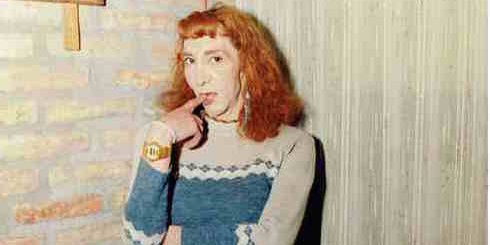
Laura Dominique Pilleri was serving a sentence when she became the first woman from Córdoba in prison to obtain her new ID. A trans woman, activist, writer, university student, and sex worker, she died in October 2015. This installation at the National University of Córdoba—also accessible online—commemorates her life and struggles with the slogan: “No one knows what a body can do.” By Alexis Oliva, from Córdoba. Photos: Colectivo Salchichón Primavera. Laura Dominique Pilleri earned a prison-style title of nobility: The Countess. Among many other things, she was a pioneer in the fight for trans rights in prison. And she was the first trans woman from Córdoba to obtain an ID with a female identity. It was her passport for transfer to a women's prison. She died in October 2015, a month after her release. An interactive installation at the Museum of Anthropology in the Faculty of Philosophy and Humanities at the National University of Córdoba recovers the story of this multifaceted figure. With the slogan "No one knows what a body can do," the exhibition by the Salchichón Primavera Collective rescues her memories and struggles. A pair of elegant, worn, dark leather high boots serves as the iconic image used in the exhibition. The members of Salchichón—Laura Zanotti, Pío Longo, Melina Alzogaray, Elena Pollán González, and Soledad Crocce—invite visitors to explore an interactive circuit featuring stories, documents, interviews, objects, and visual and auditory traces of Laura Pilleri's life.

"The Countess strikes Cordoba again"
On October 29, 1961, La Condesa was born Ricardo Jesús Pilleri in Córdoba, Argentina. She was six years old when her father abandoned her. At twelve, she experienced her homosexual awakening, and at fifteen, tired of attempts to "cure" her, she left home. She became a transvestite, a traveling stripper, and an occasional sex worker. In 1988, she contracted HIV. She went in and out of prison, serving a long sentence for robbery. In 2015, Law 26.743 allowed her ID to reflect the name she had been using for years, and facilitated her transfer to a women's prison. These are some of the highlights of her story. CountessAdding to her legend are a syringe filled with her blood brandished before horrified pharmacists, the rumor that she "owed a death to someone," and her glamorous and popular style. A sensationalist headline in an already yellowed newspaper amplified the dark side of the myth: "The Countess returns to terrorize Córdoba." Today, the Museum of Anthropology at the Faculty of Philosophy and Humanities of the National University of Córdoba (FFyH-UNC) is the home and institutional support for the exhibition, which can be accessed online at www.la-condesa.com. Alternatively, it can be viewed from the museum's main hall by scanning the QR codes scattered across the map of Córdoba's sewer network on the floor with a smartphone. In this cartography, the materials "merge and shift like an organ that beats and expands and cries out and remains alive if someone decides to read it. The materiality is total and effective. There was no selection process." Laura's belongings are given completely, unconditionally, without asking for anything in return; they are added to the flow of desire.”.
Being a transvestite, a ticking time bomb
The visitor will find 26 numbered boxes, in no particular order, containing various materials. For example, in the box 10, the handwritten testimony of the protagonist: “Exclusion, marginalization, discrimination, social and moral prejudices… prevented me from accessing secondary or higher education. Nor did they allow me to find decent work. How could I survive? I didn’t have many options. I ended up (as still happens with young people) working nights, being treated as an object paid for sexual services.”. In the box 26793Her sister Claudia reads a text by Laura published in the magazine DeodorantFrom the UNC: “She was no longer called Jesucito, but La Condesa. To speak of La Condesa was to speak of the most popular transvestite in the city, not only because of her resemblance to a woman, but also because of the threats made to the pharmacists on duty when she appeared with a syringe full of her blood, saying: 'I have AIDS. Give me this list of remedies or I'll inject you.' Among that list, seemingly of salvation, was solid anesthetic to prepare a kind of homemade cocaine that she sold at exorbitant prices to her friends.” In an interview (box 331(minute 1:33), Claudia says: “Back then, 35 years ago, being a transvestite was a ticking time bomb.”. [caption id="attachment_2978" align="aligncenter" width="890"] La Condesa, Córdoba.[/caption]
Studying in prison
Laura attended school in prison, had perfect conduct, and graduated high school in 2006, working as a bodyguard. Literature was her vocation and talent. Through the University Program in Prison (PUC), she pursued a degree in Modern Literature at the National University of Córdoba (UNC), maintaining a 7.20 GPA. In 2014, she and her sister published a book of poems and short stories. Orange peelIn early 2015, she met two members of Salchichón Primavera at a workshop. They invited her to undertake the reconstruction of her own life story. For her, it would be paid work, and part of the purpose was "to accompany her in her process of release from prison." Imprisoned since 1997 for armed robbery, she completed her sentence on September 14, 2015. Upon her release, she was not ill. On Saturday, October 17, five weeks after regaining her freedom, she died of a heart attack. She was 53 years old. The black plastic bags containing her belongings and prison clothes remained untouched. And her initial plans were cut short.
An activist behind bars
“After Laura’s death, we will change forever”. This is written on one of the cards of the creative process, supervised by the Research Center of the FFyH, contained in the box 9The protagonist's absence threw the project into crisis, but it didn't kill it. It redirected it and sparked questions. "How many people die after spending twenty years in prison? What were Laura's five weeks of freedom like?" "When we met Laura, we thought she was a very rich character, capable of showing how the whole world can be contained within one person. She was very complex: She was in jail, she was a transvestite, a sex worker, she went to college, she was a writer, she was HIV-positive, and more.”, he tells Present Melina Alzogaray, a graduate in History and an audiovisual artist. For Elena Pollán González, a Spanish documentary filmmaker and feminist activist, the Countess, “despite everything she faced, always chose to give herself as much freedom as possible regarding her identity and her way of life, without caring about any moral questioning.” Her figure “was powerful because she was active, from prison, as a trans woman. And she had contact with many communities and organizations on the margins of Córdoba, a city where many of these identities are punished.”
"She was part of the other Cordoba"
“We wanted to work with someone who could touch on those boundaries and our own contradictions. “When Laura died, reconstructing her story was a huge responsibility, and we wondered whether to continue or not,” explains Laura Zanotti, an audiovisual artist. “Then we realized that she…” It encompassed the fight for all these rights”. Pío Longo, screenwriter and audiovisual producer, recalls: “It was a huge challenge to let go of that first attempt and, at the same time, not let go of Laura. We realized, with the help of some theories and a lot of work with our emotions, that grief could be an opportunity to rethink the power of these precarious lives and these vulnerable bodies and to build political community.”
-What does Laura Dominique Pilleri represent?
MA: That's what we're trying to answer with this work. Among other things, she represents the freedom to desire and love as one feels, without being judged for it. PL: She was part of the other Córdoba. Alongside the Córdoba that overwhelms, frustrates, and drags us down, there's also the March of the Cap (against the code of misdemeanors), the fight against Monsanto, the activists of AMMAR (Association of Sex Workers of Argentina), and some sectors of the university, all products of Córdoba's resistance.
Pío Longo, screenwriter and audiovisual producer, recalls: “It was a huge challenge to let go of that first attempt and, at the same time, not let go of Laura. We realized, with the help of some theories and a lot of work with our emotions, that grief could be an opportunity to rethink the power of these precarious lives and these vulnerable bodies and to build political community.”
-What does Laura Dominique Pilleri represent?
MA: That's what we're trying to answer with this work. Among other things, she represents the freedom to desire and love as one feels, without being judged for it. PL: She was part of the other Córdoba. Alongside the Córdoba that overwhelms, frustrates, and drags us down, there's also the March of the Cap (against the code of misdemeanors), the fight against Monsanto, the activists of AMMAR (Association of Sex Workers of Argentina), and some sectors of the university, all products of Córdoba's resistance.
"Her way of desiring, loving, and dressing is unsettling."
-What is the Countess using to punish Cordoba? MA: Laura makes Córdoba uncomfortable, and that's why she's being harassed. Her way of desiring, of loving, of dressing, of speaking, her smell, her gaze, her friends, her way of living, of walking down the street, her choice of work, the fact that she's HIV-positive—all of it makes her uncomfortable. And the fact that a trans woman and a sex worker is at the university is also unsettling. EPG: In Córdoba, there is very strong repression against sex workers, and an issue with identity, which appears in femicides and transphobic murders. Even with marriage equality, it's difficult to continue living in these spaces as a lesbian, trans, or travesti person. Things don't happen on the street as they do within the law. Bodies that aren't perceived as heterosexual women and men continue to be violated in every space. La Condesa attracted all of that and much more. And she carried those struggles inside the prisons. PL: Even in the small, conservative pockets of progressivism and the left, she was a thorn in their side. She was a thief, she swindled. There's a tradition within the left and progressivism of wanting to see only certain aspects of people. And Laura was brazenly complex and contradictory. LZ: And besides, Laura had her Bible and her holy cards. We never inhabited a prison in the sense of being incarcerated. And those beliefs were her support. That's part of La Condesa: on the one hand, anti-purity, but also the Bible. That makes her human, makes her flesh, character, and myth, and it doesn't absolve her of being a believer.
Access the exhibition online: http://la-condesa.com/
To visit the exhibition in Cordoba:
Museum of Anthropology of the Faculty of Philosophy and Humanities of the National University of Córdoba (FFyH-UNC)
Hipólito Yrigoyen Avenue 174, Córdoba.
From 9 a.m. to 5 p.m. Free admission.
]]>We are present
We are committed to journalism that delves into the territories and conducts thorough investigations, combined with new technologies and narrative formats. We want the protagonists, their stories, and their struggles to be present.
SUPPORT US

FOLLOW US
Related notes
We are present
This and other stories are not usually on the media agenda. Together we can bring them to light.