

The CHA turned 33 and presented a book about trans children
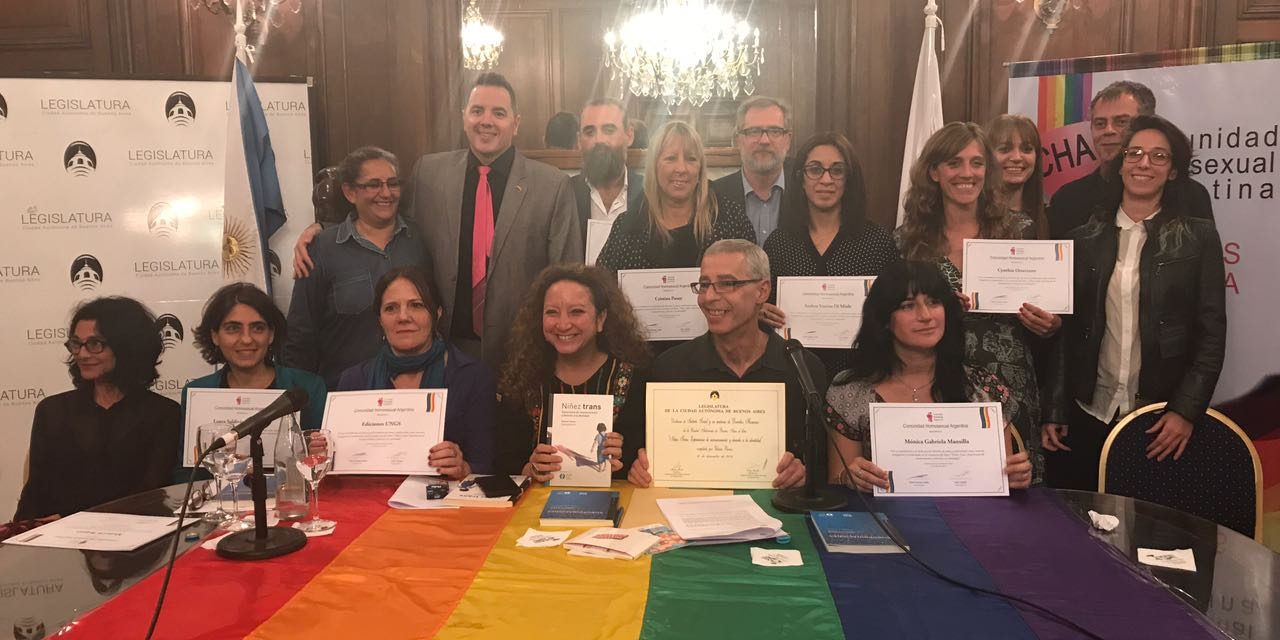
To commemorate its 33rd anniversary, the Argentine Homosexual Community (CHA) presented the book "Trans Childhood," declared of social interest in the field of Human Rights by the Legislature of the Autonomous City of Buenos Aires. They also reviewed the "titanic victories" throughout their history.

Share

In commemoration of its 33rd anniversary, the Argentine Homosexual Community (CHA) presented the book "Trans Childhood," declared of social interest in the field of Human Rights by the Legislature of the Autonomous City of Buenos Aires. They also reviewed the "titanic victories" throughout their history. The Argentine Homosexual Community (CHA) celebrated its 33rd anniversary and, within this context, presented the book "Trans Childhood." “Experience of Recognition and the Right to Identity,” compiled by the organization and published by the National University of General Sarmiento (UNGS). During the event at the Buenos Aires City Legislature, CHA President César Ciglutti reviewed the main achievements of the Argentine LGBTI community. He called for the approval of trans quota laws and an end to the repression against LGBTI people, among other demands. The packed Montevideo Hall listened to the panel comprised of the CHA president; Gabriela Mansilla, mother of Luana, the first trans child to obtain an identity document reflecting her gender identity; Buenos Aires City legislator Andrea Conde (Front for Victory), president of the Women, Adolescence and Youth Committee; UNGS Rector Gabriela Diker; and Gabriela Paván, compiler of the book and vice president of CHA. “Trans Childhood” was declared of social interest in the area of Human Rights by the Legislature of the Autonomous City of Buenos Aires (CABA), through Resolution 964/16. “This initiative helped bring the issue to light and allow for a vote in this forum,” Andrea Conde noted. She emphasized the importance of making “these issues visible, especially in a context where the government is obstructing the distribution of hormones, and where there is an escalation of police repression against the most vulnerable bodies, against women, lesbians, and trans people,” she denounced. In turn, Gabriela Mansilla's mother highlighted: “Here, the struggle we are waging is being recognized, which is nothing more than giving our children a future.” And she pointed out that the publication of the books “ Yo nena, yo princesa” (Me, a girl, me, a princess ) and “Niñez trans” (Trans children) (both compiled by CHA and published by UNGS) demonstrates “that there is much to be transformed in the entire education system.”
No place in academic agendas
The rector of UNGS pointed out that Transgender issues still don't have much of a place on academic agendas.“There is little research in academic fields, across various disciplines. The gender perspective has not yet permeated the training of professionals who work in different areas and who deal with gender issues on a daily basis,” she stated. “Publishing these books is a decision that makes the academic world uncomfortable, but we believe that is the role of intellectuals. Where we think there are certainties, that is where we need to challenge the status quo, to make things uncomfortable and shake up what we do,” she affirmed. The role of public universities is “to make resources available to reflect on the problems that are beginning to emerge, the rights that need to be recognized, and the knowledge that needs to be reproduced,” she added. Gabriela Paván, who is also the health coordinator for CHA, said that Luana's experience has institutionalized diversity in childhood. She recounted that after her story was shared, many families approached the organization with questions about their children. “The experience keeps expanding and Luana has a lot of role models to look up to.”The titanic conquests
The closing remarks were delivered by the president of CHA, who thanked the activists from all LGBTI community organizations, stating that “no one ever did it alone.” He said this before reviewing the community’s “13 main achievements,” summarizing the organization’s 33 years. He recalled the groups Nuestro Mundo and Frente de Liberación Homosexual (FLH) as its predecessors. He also reminisced about CHA’s beginnings in 1984 at the Contramano nightclub, where a group of people came together with the primary objective of fighting against repression and the police edicts inherited from the dictatorship. “For eight years, we were the first organization to confront that situation, with Carlos Jaúregui at the helm.” He referred to obtaining legal status, a struggle achieved through international action; and to the LGBTI Pride March, which has been held for 25 years “with ever-increasing participation.” The Buenos Aires City Constitution, which included non-discrimination based on sexual orientation in 1996; the Civil Union Law in 2002, the first step toward marriage equality; the Comprehensive Sex Education Law in 2006; the survivor's pension in 2008; the Equal Marriage Law; the Gender Identity Law; the Assisted Human Reproduction Law, which included same-sex couples; the regulations implementing the Gender Identity Law; the end of the ban on homosexuals donating blood two years ago; and the inauguration of the Carlos Jáuregui subway station. "Each of these achievements was monumental, and some took years of work, which is why it's so important to remember them," he noted. “Within the framework of human rights, the struggles of our entire community are efforts to build a more diverse, inclusive, and egalitarian society. And this same framework is what allows us to see the full inclusion of all LGBTI people. That is why we insist that it is essential to pass the trans quota laws and stop police repression against LGBTI people throughout the country,” Ciglutti urged. She also demanded the approval of the amendment to the anti-discrimination law, a request that has been made for 29 years. “Our inspiration and our motto at the origin of our struggle is the desire for all freedoms,” she concluded.We are present
We are committed to journalism that delves into the territories and conducts thorough investigations, combined with new technologies and narrative formats. We want the protagonists, their stories, and their struggles to be present.
SUPPORT US

FOLLOW US
Related notes
We are present
This and other stories are not usually on the media agenda. Together we can bring them to light.