

The artist behind the mural at the Carlos Jáuregui subway station
When he was 15, Daniel Arzola suffered his first homophobic attack: someone tried to set him on fire and burned his genitals with cigarettes. Ten years later, this Venezuelan artist in exile became an activist, founding the global campaign “I’m Not Your Joke,” which even reached Madonna herself. While in Buenos Aires, he spoke with Presentes about his story and his “encounter” with Carlos Jáuregui.

Share

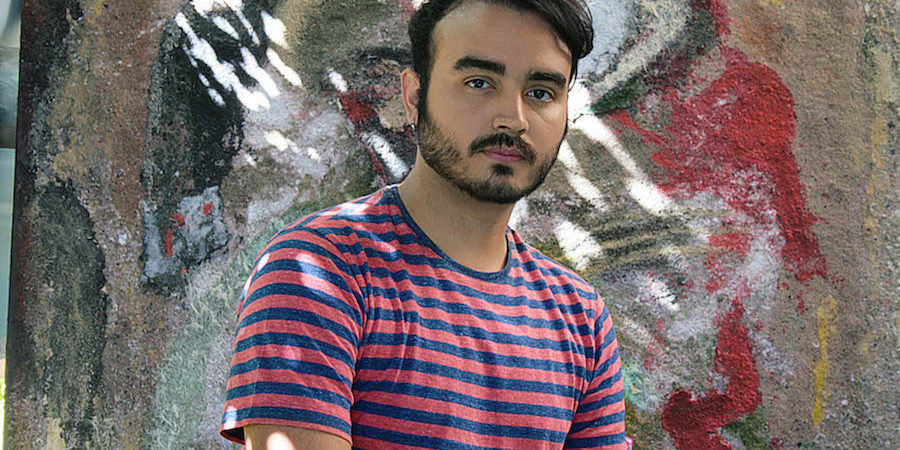
When he was 15, Daniel Arzola suffered his first homophobic attack: they tried to set him on fire and burned his genitals with cigarettes. Ten years later, this Venezuelan artist in exile became an activist. His global campaign, “I’m Not Your Joke,” even reached Madonna. While passing through Buenos Aires, he spoke with Presentes about his story and his “encounter” with Carlos Jáuregui. By Lucas Gutiérrez. Photo: Benjamín Araneda. Daniel Arzola is a Venezuelan emblem of artivism: art + activism. Having grown up in a homophobic environment that more than once brought him to the brink of death led him to create his campaign, “I’m Not Your Joke.” With it, he raised his voice to deliver a message of struggle and resistance to the world. “I have to send a little bottle, a message, telling the world, ‘I existed,’ because they’re going to kill me.” This was the thought that drove him to action. She's about to turn 28, her curls are neatly styled, her smile is always kind, and her slightly tired eyes speak of her story. She walks through the streets of Buenos Aires after the inauguration of the Carlos Jáuregui subway station on Line H. It's the first in the world to bear the name of an LGBTQ+ activist. Jáuregui was a pioneering activist in raising the visibility of the LGBTQ+ community, and a mural by Arzola shapes the identity of this space that pays tribute to him.
[READ More: Carlos Jáuregui, the unforgettable faggot]
 “In Latin America, when we talk about gay role models, we talk about Harvey Milk. Why don’t we talk about Jáuregui? I’m sure there are other Jáureguis in other Latin American countries. We need to know our Latin American history and say, ‘You know what? Our role models weren’t so far north,’” he says.
"Why can't you be more of a man?"
That's what the police asked him when, at 15, a gang tried to set him on fire and extinguished cigarettes on his genitals. This hate crime made him feel trapped in a flat world: "It was Daniel Arzola against flat worlds," he explains. In his own illustrations and urgent messages, he found a way to give depth to that flatness. 'I'm not your joke' It bears Arzola's signature style. Translated into various languages, this LGBT awareness campaign even reached artists like Madonna, who tweeted her support. This gave it visibility, a voice against homophobia, and highlighted what the artist was experiencing in Venezuela. – In Venezuela, there is state-sponsored homophobia; the government systematically uses homosexuality to attack its adversaries. Arzola recalls, among many examples, the time when the Venezuelan President Nicolás Maduro said: “I do like women.” On broadcast television. “From then on, they validated the idea that if you’re gay, you’re not a man, you’re defective. And I started exposing these things,” he explains. This visibility brought threats. He was 24 years old and had guns pointed at him four times, while the intimidation continued to escalate. The Dutch organization Radio Nederland Wereldomroep (RNW) invited him to Amsterdam Pride 2014. There, they told him that most of the people from Venezuela they had worked with were either imprisoned or dead. In 15 days, Daniel made his decision. After that trip, he never returned to his country.
 “Oscar Wilde said that you can spend a long time not living life, and then suddenly life is concentrated in a single moment. For me, these last three years have been my moment, dying and being reborn. You have to relearn how to speak, how to communicate with people, how to walk because you have no idea where you stand. Sometimes I feel like I only have three years to live.”
The LGBT exile
The organization RNW helps relocate people persecuted for their sexual orientation or gender identity. And Daniel Arzola chose Buenos Aires. He knew people, and a love interest brought him south. But the relationship lasted a month, and he found himself “in exile and heartbroken.” When his roommate took his belongings, Daniel went down to a plaza to cry, opened the dating app Grindr, and met a police officer who offered to help him recover his things. A year later, he now lives in Chile.[READ MORE: « Carlos Jáuregui Station, the first LGBT station in the world» ]
-What is it like to be an LGBT exile? "I don't see myself that way; I'm more of an intersection. Besides being part of the gay community, I have a diagnosed form of autism called Asperger's. These things constantly intersect. My whole life I've felt like an alien, so what's one more stripe on a zebra? I prefer to invest my time in people who empathize with me and find beauty in my differences, in my accent, in my food, in that kind of thing. But one thing I'm sure of: I don't believe in homelands." I believe that your homeland is one, your heart, and your friends. I don't think it's an extract and an imaginary god that should be worshipped.
A meeting with Jáuregui
On one of those dreary afternoons, walking through the Buenos Aires neighborhood of Abasto, she came across a photo taped to a wall. It showed a “little guy with glasses and a flannel shirt” who she thought was very handsome. “He reminded me of a porn actor.” Below it was a name that she later googled “Jáuregui. That’s how they met. Daniel says he felt like he was looking at a rock star. As soon as he heard about the proposal for the station, he started sketching and contacted those in charge. “I told them that the campaign they were doing was awful: 'This Jauregui is modern, show him alive, don’t show him dead, distant, because What that guy dreamed is what we are living right now. Show him as if he were here today.' That's what I wanted to convey with the drawing." Today, the 14-meter mural is located at the Santa Fe/Carlos Jáuregui station, visible to thousands of people who pass by, see it, discover it, and perhaps even search for its name online. “It’s a favor I’m returning,” says Arzola.
[READ MORE: «Jáuregui in writing»]
A straight person can identify with thousands of people, but it's more difficult for a trans girl or a queer boy. For me, this is about telling children: 'You know what? There are people like you. You can be like any of these characters when you grow up, have a family, be happy, enjoy life, and feel proud of who you are.' It's very important to recognize yourself.
The open wounds of Daniel Arzola
“Venezuela has become a prison for me,” he says. He’s been waiting for his passport since November; without it, his planned exhibitions would fall through. And despite the letters, emails, and complaints he sends, there’s still no response. “I miss my people back home, because unfortunately, I won’t be able to miss a place that hurt me so much,” Daniel says. That’s Daniel’s life, like a heart that beats and systoles, suddenly full and then empty. “I’m alone in another country, I work a lot because I feel like otherwise I’ll end up on the street,” he says, adding that it’s hard for him to stop and enjoy himself. And yet he keeps going. Daniel doesn’t stop. “The world cannot sleep in freedom because you wake up a prisoner.””, he concludes.Follow Presentes:
Twitter @PresentesTLGBI Instagram: PresentesLGBTI Facebook: https://web.facebook.com/presentesLGBTI]]>We are present
We are committed to journalism that delves into the territories and conducts thorough investigations, combined with new technologies and narrative formats. We want the protagonists, their stories, and their struggles to be present.
SUPPORT US

FOLLOW US
Related notes
We are present
This and other stories are not usually on the media agenda. Together we can bring them to light.