

Effy: between performance and intimacy
She wrote love letters to Roland Barthes and was a huge fan of The Little Mermaid. She could eat alfajores for dinner and fantasized about owning a sex shop. Behind the overwhelming image of her performances, there was also a fragile, capricious person, with her quirks and anecdotes. Her parents, friends, and colleagues remember her in this collective portrait.

Share

She wrote love letters to Roland Barthes and was a huge fan of The Little Mermaid. She could eat alfajores for dinner and even fantasized about owning a sex shop. Behind the overwhelming image of her performances, there was also a fragile, capricious person, with her own quirks and anecdotes. Her parents, friends, and colleagues remember her in this collective portrait.
By Lucas Gutiérrez Photos: Effy and Leticia Avila's personal archive
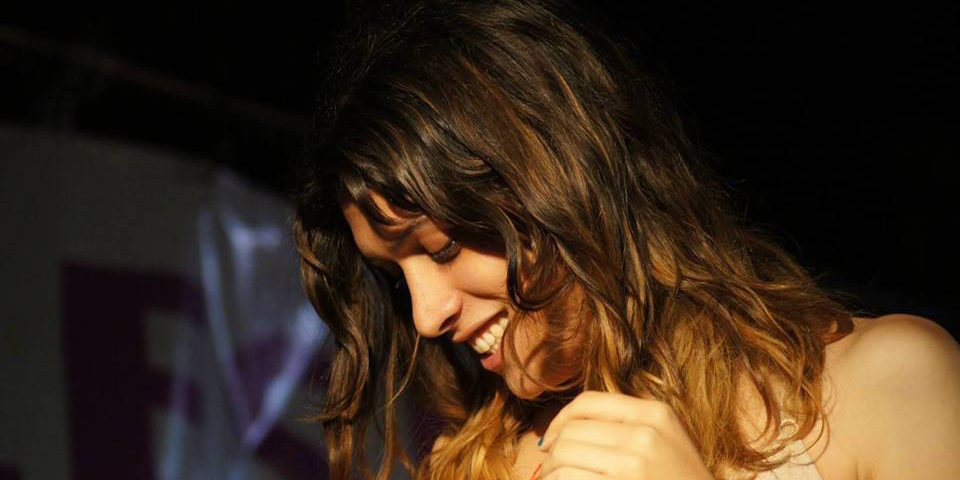
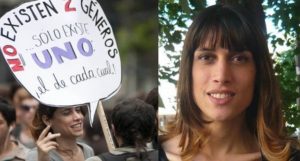
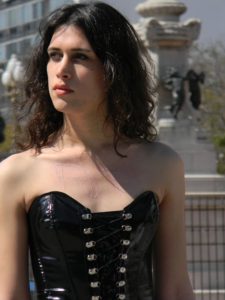
Effy cutting her arms on stage. Effy walking through the Pride March with pruning shears and her genitals exposed. Effy writing with her blood. Effy asking to be drawn. Effy challenging and problematizing gender. The trans performer Elizabeth Mía Chorubczyk, Effy, left an artistic legacy that still challenges us and will continue to be discussed for a long time. But she was also a daughter, friend, girlfriend, and more, who today remember her with anecdotes. When she began her transition, someone told her: “You’ll never be a woman because you don’t menstruate.” Effy extracted half a liter of blood from her body and divided it into thirteen “performative menstruations” that she performed month after month. And now we can see her in the footage that shows her letting this blood fall from her most fertile organ, her head. Strong and intimidating on stage, in everyday life she asked for help to interact with people. She was also those contradictions.
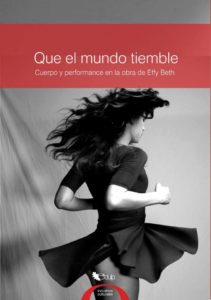
[READ ALSO: #Books: Let the World Tremble, Effy's Memoirs ]
When she and her then-partner, Laura Gam, took a photo in which they digitally swapped their genitals, we thought that was their private life. But three days after Effy's suicide, there was a memorial service at the Tierra Violeta Cultural Center, and Laura displayed her there even more naked.
“Effy loved Jorgito alfajores, the ones in the purple package. Not the red ones, not the green ones, not the blue ones, only the purple ones. Every time she opened the refrigerator at my house and saw them, I had to threaten her so she wouldn't eat five at once, because what followed wasn't just that she didn't want dinner afterward, but a terrible stomach ache that only subsided when I put a drop of Pink Yarrow (one of the Bach flower remedies) on her tongue.”
Gestures
In another performance, she asked people to draw her to explore the theme of femininity. But wherever there was a pencil and paper, Effy would draw something and give it to whoever was with her. That's why she liked to go to dinner at the restaurant 'Las Cabras' where the tablecloth is paper and you can draw on it with crayons. That's why everyone has a drawing of hers or a phrase from it.
On her mother Dori's birthday, she left clues everywhere to lead her to the gift. Another time, she asked her to trust her, blindfolded her, and put her in a taxi. They went together to the Malba to enjoy one of Dori's favorite films.
Siren
At eight years old, she claimed the family camera for herself. There are photos from that childhood, and in every one, the same thing: a child, camera in hand. At eleven, she took a cartooning course. Years later, she poured that knowledge into the comic book TRANSita, where, with biting humor, she recounts her transition. In boxes of memories, among old photos and cartoons ranging from Mercedes Sosa to Madonna, the journey of this artist is complete, even before she herself.
Dori confirms what is already known (“she could eat a whole packet of Melba cookies for dinner”) and shows a collection of Effy's mermaid ornaments. She was a huge fan of the movie 'The Little Mermaid' and knew the song “Poor Unfortunate Souls” by heart. Mermaids were her personal metaphor. “As a child, the soles of her feet were so sensitive that she couldn't walk on sand or grass, and forget about having her toenails cut,” her mother says.
Quirks and gifts
Bocha, her father, remembers her protesting because she wouldn't eat if the colors of the food on her plate were mixed. "Unless it had Bolognese sauce, in which case it didn't matter at all because she loved that sauce."
Father and child had their share of difficult moments: "When she wanted to ignore you, it was terrible. But when she came home and I was watching TV, she'd ask me to get up so she could give her a hug."
Six months before she passed away, she left him a gift: she put together the family tree on the Chorubczyk side. She visited and contacted cousins she hadn't spoken to in years, reconstructing and expanding those branches. She left him that, and a fascination with Tarantino. They always went to see his movies together.
Put me a sex shop
She struggled to socialize. Once, she told her father he should set her up with a sex shop. It was the ideal job: little exposure and not much contact. But she surely would have spent her time questioning and engaging with the clientele, and from there she would have drawn material for some of her performances.
The books Effy devoured are now at her mother Dori's house. Inside Roland Barthes's "Camera Lucida," there's a letter. In it, a love letter from Effy to Barthes, where she describes (to a philosopher who died nine years before she was born) the romance they would have had.
Besides art books, artworks, and novels, in her corner you could find a Lana Del Rey CD and Lady Gaga music.
“When I think of Effy, I think of her as an activist; it’s difficult for me to remember her outside of her performances or interventions. This doesn’t mean she lived in an artistic pose 24/7: for me, Effy the artist and Effy the human are intertwined. Effy the artist creates a language with which Effy the human speaks,” says Matías Máximo, who, along with María Julia Prut and Dori, compiled the book with all her work. (link: http://libros.unlp.edu.ar/index.php/unlp/catalog/book/654 )
Games
When she visited her friend Maria Julia, Effy would arrive with pastries piled high with dulce de leche, but she'd immediately head to her 9-year-old daughter Valentina's room to paint her nails. Because while she might have questioned makeup and the role of femininity, these games fascinated her. Like when she'd ask her friend Victoria Sequera to paint her nails blue, and then they'd apply and reapply makeup. "We had so much fun doing silly things, and I'd melt seeing her smile like that, her upper lip curling into a little canopy, and her head tilting back," she recalls.
Return in the rain
On March 8th, during the International Women's Strike march, Sequera lost her wallet. Inside was a letter Effy had written her for her birthday in 2014. Whoever found it contacted Effy's friends, and a chain of friends worked together until it was returned. The wallet reappeared in the rain, because ever since Effy committed suicide, it always returns with rain. When the hearse carried away the name she had fought so hard for, it carried her away under a downpour of gray skies. When her plaque was unveiled at the cemetery, it was raining. When an exhibition of her work was held at the Cárcova Museum, a storm broke out.
When I no longer tremble
True to form, Effy left instructions before she left. She organized her work, perfectly archived on her computer, and even left a profile picture on social media indicating how to proceed. Three days before her final day, March 25th, at a wedding, she asked her mother to take her picture. Effy had many photos of performances, many others taken by artists, but few of her simply as herself. “I want one you’ll really enjoy looking at,” she told her mother and uploaded it to her Facebook page.
“It seemed strange to me because she didn’t allow herself to be photographed in her personal life, but it was another sign she gave me that day. Like when, at the wedding, she hugged me, cried loudly, and said, ‘Mom, I’m leaving.’ And I told her not to leave the wedding. But she was telling me she was leaving us,” Dori recalls, sitting among Effy’s books, photos, and drawings.
Another clue was the caption of that photo, which is still her Facebook profile picture: “Let the world tremble when I do not.”
As she explained to this reporter in an interview, she signed her works as effýmia because: “Effy is Elizabeth’s nickname, Mia is my middle name, and when combined in ‘effýmia’ it sounded like bulimia or anemia, something clinical. I decided to always use lowercase so that it wouldn’t be my name; my name is Elizabeth, and I wanted to be able to differentiate it from my artistic practice, where I don’t create an alter ego or character, but rather generate an impulse, a way of seeing life, of seeing myself.”
]]>
We are present
We are committed to journalism that delves into the territories and conducts thorough investigations, combined with new technologies and narrative formats. We want the protagonists, their stories, and their struggles to be present.
SUPPORT US

FOLLOW US
Related notes
We are present
This and other stories are not usually on the media agenda. Together we can bring them to light.
What can I say?
I miss her, and life is hard without her. Thank you, Lucas, and everyone who brings her to our attention in notes like these. Thank you for allowing her to be present every now and then and for keeping her alive once again. Hugs. Dori