Follow Presentes:
Twitter
@PresentesTLGBI Instagram:
PresentesLTGBI Facebook: https://www.facebook.com/presentesLGBTI/
@PresentesTLGBI Instagram:
PresentesLTGBI Facebook: https://www.facebook.com/presentesLGBTI/
 Support us
The annual report from the Movement for Homosexual Liberation (Movilh) also revealed that, for the first time in 12 years, there were more reports of violence filed by lesbians and transgender people than by gay men. Illustration: Florencia Capella. Every year, the Movement for Homosexual Liberation (Movilh) produces a comprehensive report documenting violence…
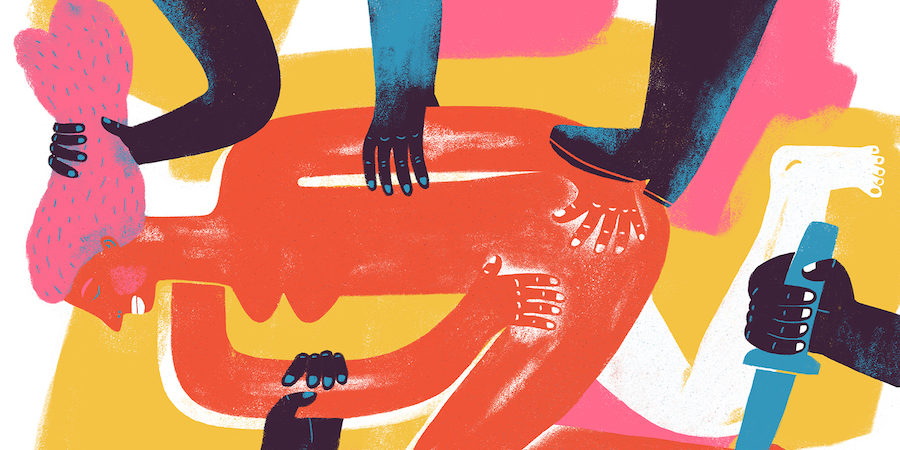
The annual report of the Homosexual Liberation Movement (Movilh) also revealed that, for the first time in 12 years, there were more complaints filed by lesbians and trans people than by gay men.
Illustration: Florencia Capella.
Every year, the Movement for Homosexual Liberation (Movilh) produces a comprehensive report documenting violence against the Chilean LGBTI population and monitoring public policies. The 15th Human Rights Report, published this month, indicates that 2016 was the “year of multisectoral transformations in favor of equality and non-discrimination.” The organization refers to the Agreement for Equality , the document in which the State committed to the LGBTI community through a series of anti-discrimination policies.
But it was also the year that complaints increased by 28.6%, with 332 cases : 4 murders; 40 physical or verbal assaults perpetrated by strangers; 3 police abuses; 32 workplace abuses and 13 educational abuses; 37 homo/transphobic campaigns; 79 instances of institutional exclusion; 19 denials of products or services; 56 community attacks (family, friends, neighbors); 48 hate speech incidents; and 1 instance of discrimination in the media.
Compared to 2015, hate crimes increased by 33%, with 4 homicides, while police abuses rose from 0 in 2015 to 3 in 2016.
“In the first case, the importance of perfecting and reforming the Zamudio Law is reinforced so that the aggravating criminal penalty can be effectively applied, and in the second case, the need to intensify anti-discrimination policies in the Carabineros is highlighted.”
Reports of workplace and community homophobia/transphobia (family, friends, neighbors) increased by 100% and 80.6%, respectively. “This reflects greater empowerment to demand rights in spaces that are often difficult, as they share the common denominator of generating a certain economic and/or emotional dependence between the victim and the perpetrators,” the report states.
For the first time in 12 years, transgender and lesbian people reported more abuse than gay men, accounting for 28%, 24%, and 23% of all cases, respectively. Meanwhile, 25% of the abuses affected the LGBTQ+ community as a whole.
“In the case of the trans population, the increase is explained by their demand for rights in areas where they previously self-marginalized due to discrimination, such as education and employment.”
The lesbian population, for its part, increased its complaints across all sectors, especially in the workplace, education, and family life.

Cases of systematic torture in the Chilean Gendarmerie were reported, as well as instances of workplace discrimination at the CNCA in Maule and violence against bisexuals in a women's shelter funded by the Ministry of Women and Gender Equity.
In the realm of public policy, there was widespread progress toward equality.
The Ministry of Health rejected, for the first time, conversion therapies and repealed a pre-reform that stigmatized the LGBTI population by associating them with sexually transmitted diseases. Meanwhile, in Education, the inclusion of the International Day Against Homophobia and Transphobia in the School Calendar reached all regions of the country.
For its part, the Ministry of Women and Gender Equity incorporated the realities of lesbian, transgender, and bisexual people into some of its policies. Among other points, this meant that the murders of women by same-sex partners were included in the list of femicides.
Meanwhile, the Ministry of the Interior became the first government agency to collaborate with the LGBTI movement in providing support to victims of violence. The National Youth Institute (Injuv) launched regional commissions against homophobia and transphobia. The Labor Directorate extended the five days of paid leave granted to married couples to civil partners in the private sector.
In 2016, the Judiciary conducted a study to understand and measure the levels of discrimination among its officials, addressing for the first time exclusion based on sexual orientation and gender identity.
]]>

We are committed to journalism that delves into the territories and conducts thorough investigations, combined with new technologies and narrative formats. We want the protagonists, their stories, and their struggles to be present.

This and other stories are not usually on the media agenda. Together we can bring them to light.