

#8M Lesbians were repressed and arrested: "it was a police hunt"
“The police threw us to the ground and kept saying, ‘Kid, kid, stay calm,’” said Amanda, one of the lesbians beaten and illegally detained by the police. Some were taken to the 1st Police Station, others to the 4th Precinct station, at Zabaleta and Chutro. All were released this morning.

Share

“The police threw us to the ground and kept saying, ‘Kid, kid, stay calm,’” said Amanda, one of the lesbians beaten and illegally detained by the Metropolitan Police in Buenos Aires. Some were taken to the 1st Police Station, others to the 4th Precinct station, at Zabaleta and Chutro. All were released this morning. They denounced degrading searches and police abuse. [NEWS UPDATED at 6:30 PM on 3/9] Following the arrest and subsequent release of about twenty women during the Women's Strike march, the Ni Una Menos Collective denounced the actions of the security forces as illegal. This statement was made during a press conference held this afternoon at the Center for Legal and Social Studies (CELS), along with other organizations. There, they said the operation was “arbitrary.” Paula Litvachky, director of the Justice Area at CELS (Center for Legal and Social Studies), described the operation as “a police witch hunt.” “These are prohibited police practices,” she emphasized. She added that this is followed by the fabrication of charges to justify the detentions, which “sends very clear messages of criminalizing protest.” Maria Rachid, director of the Institute Against Discrimination in the City of Buenos Aires, said the arrests were “clearly arbitrary” and denounced that “there was no intervention by either the Executive or the Judiciary that would have allowed for the release of our detained comrades.” “The Judiciary had the means to act more swiftly and failed to do so,” she stated. The women were arrested hours after the #8M march in the downtown area and were released this morning. Four were taken to Argerich Hospital with injuries and have since returned home. “They were all released; they were treated terribly at the police station, subjected to degrading searches.” Luciana Sánchez, a lawyer who was demanding the release of the women and feminists until this morning, told Presentes
Police abuse by the Metropolitan Police is denounced
Some were taken from nearby pizzerias, others from Plaza de Mayo, after the march had already ended. "It was very difficult. They were shot with rubber bullets, subjected to degrading searches at the police station, and forced to do push-ups. Their release was delayed, even though the judge had ordered their release many hours earlier, and although the arrests were illegal," Sánchez reported. Immediately after the arrests, the lawyer filed a writ of habeas corpus with the duty judge, No. 16, Laura Bruniard. "The habeas corpus allows us to verify how long the police took between the judge's order for the release of our comrades and the Metropolitan Police carrying it out. This is an irregular action, and the habeas corpus is proof of that," Sánchez said. From now on, the following will intervene in the case: the Office of the Prosecutor against Institutional Violence (PROCUVIN), the Specialized Prosecutor's Unit for Violence against Women and Lesbian, Gay, Bisexual, Transvestite, Transgender, Transsexual and Intersex (LGBTI) Persons of the Public Prosecutor's Office (UFEM); and the Directorate of Guidance, Support and Protection of Victims (DOVIC).How the arrests took place
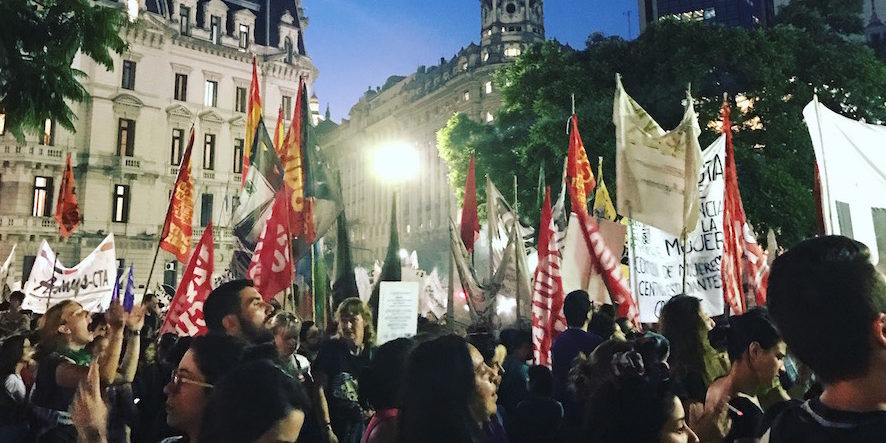
Yesterday, as the International Women's Strike march dispersed in Buenos Aires, police began to repress some women, mostly lesbians, who were in the areas surrounding Plaza de Mayo, beating and groping them. They were taken into custody at the 1st and 30th police stations, and later some were transferred to the 4th Precinct police station at Zabaleta and Chutro. It is estimated that more than thirty people were arrested. “We weren't doing absolutely anything. The police pepper-sprayed us and threw us to the ground. They kept saying, 'Kid, kid, stay calm,'” said Amanda, one of the lesbians beaten and illegally detained by the police. She was taking photos for her work with the Public Defender's Office of the City of Buenos Aires. Amapola, another of the girls arrested, sent photos of her injuries before they took her cell phone at the police station.
One woman was leaving a pizzeria in the area when she was arrested. Another was taken while waiting for the bus. Most were already on their way home when the police began their crackdown. This morning, while they were still detained, Sánchez reported: “We have already filed a habeas corpus petition for our comrades who were illegally detained, beaten, and groped by the police. Now, Judge Laura Graciela Bruniard, head of Criminal Court 16, has to respond to the habeas corpus petition. We are asking her to go to the police stations to verify the well-being of our comrades. There are also minors involved, and we don't even know what crimes they are being charged with. The judge is Alejandro Cilleruelo, from Juvenile Court No. 4, and he is ruling from his home,” she told Present The lawyer Luciana Sánchez stated, “There are minors detained, and we don’t know what crimes they are being charged with. This is a disgrace.” “When we told the police we were women, because they were calling us ‘boys,’ they said, ‘Oh, so you’re a woman, huh,’ and tightened the handcuffs very hard,” said Amanda. These are some of the testimonies that began circulating from the police station cells and also from the detainees’ friends. The pleas for help and the little information that emerged about the case were shared through social media.
Amapola, another of the girls arrested, sent photos of her injuries before they took her cell phone at the police station.
One woman was leaving a pizzeria in the area when she was arrested. Another was taken while waiting for the bus. Most were already on their way home when the police began their crackdown. This morning, while they were still detained, Sánchez reported: “We have already filed a habeas corpus petition for our comrades who were illegally detained, beaten, and groped by the police. Now, Judge Laura Graciela Bruniard, head of Criminal Court 16, has to respond to the habeas corpus petition. We are asking her to go to the police stations to verify the well-being of our comrades. There are also minors involved, and we don't even know what crimes they are being charged with. The judge is Alejandro Cilleruelo, from Juvenile Court No. 4, and he is ruling from his home,” she told Present The lawyer Luciana Sánchez stated, “There are minors detained, and we don’t know what crimes they are being charged with. This is a disgrace.” “When we told the police we were women, because they were calling us ‘boys,’ they said, ‘Oh, so you’re a woman, huh,’ and tightened the handcuffs very hard,” said Amanda. These are some of the testimonies that began circulating from the police station cells and also from the detainees’ friends. The pleas for help and the little information that emerged about the case were shared through social media.
Follow Presentes:
Twitter
@PresentesTLGBI Instagram:
PresentesTLGBI Facebook:
https://web.facebook.com/presentesTLGBI/
We are present
We are committed to journalism that delves into the territories and conducts thorough investigations, combined with new technologies and narrative formats. We want the protagonists, their stories, and their struggles to be present.
SUPPORT US

FOLLOW US
Related notes


We are present
This and other stories are not usually on the media agenda. Together we can bring them to light.