Twitter @PresentesTLGBI
Instagram: PresentesTLGBI
Facebook: https://web.facebook.com/presentesTLGBI/
 Support us
“I feel called to the Women’s Strike because it is our right as women of diverse backgrounds,” says trans activist Niki Raveau. “Lesbians are made invisible,” adds activist Claudia Amigo. They, along with other LGBTQ+ activists, are calling for people to take to the streets next Wednesday at 7 p.m.

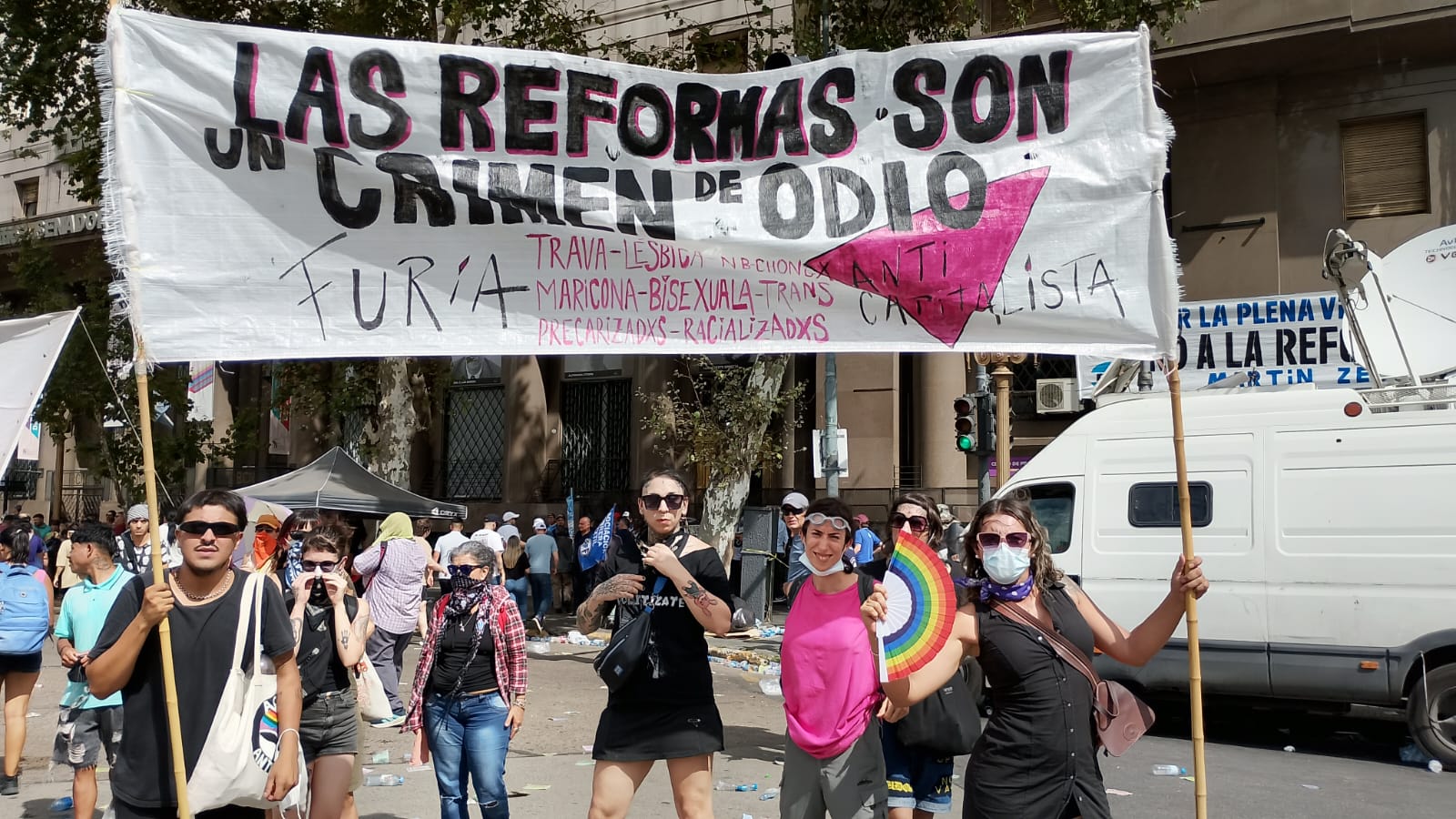
Multiple and diverse women's, feminist and critical sexual diversity movements will participate in the International Women's Strike under the slogan "If our lives are not worth anything, then produce without us."
From Chile, the women's movement #NiUnaMenos will join the international call by organizing a massive march on March 8 at 7 pm, with the main squares of the cities of Santiago (Plaza Italia), Valparaíso and Concepción as the epicenters.

Ximena Riffo, a lesbian-feminist activist and one of the spokespeople for #NiUnaMenos, calls for “slowing down activities, holding meetings in workplaces and schools, and staging bed strikes,” thus “making the call for the International Women’s Strike effective.”
For her part, Claudia Rodríguez, a trans feminist activist, applauds the cross-border initiative, highlighting its critical value: “I think it’s a powerful strategy, more critical than the Chilean perspective on femicide because marching is less problematic than directly halting women’s labor force,” she states. She also points out that within femicides, murdered lesbians are rendered invisible and that “lesbian femicides” are excluded from official reports.
Niki Raveau of Fundación Transitar says she feels motivated and called to participate in the International Women's Strike on March 8th. "The Ni Una Menos Chile coordinator asked me to make a video as a leader inviting people to march," Niki says, adding her own and collective desire to participate, stating: "I also feel called to participate because it is our right as women of diverse backgrounds. I will participate as a trans woman and as someone dedicated to creating spaces for trans children, which is my work."
From Quintay, in the Valparaíso commune, Sandy Iturra, spokesperson for the TravesChile group and emblematic fighter for the Gender Identity Law, points out that it is “important to participate in this initiative to demonstrate that women are as important as men in the workforce.”

Activist Claudia Amigo during the My Pride campaign. Photo: Lilian Permoarta
The coordination and participation of transvestite and lesbian feminist collectives will be significant in the public actions planned in Chile. In this context, Presentes delved into the struggles of sexual diversity, lesbian feminism, and the International Women's Strike with Claudia Amigo, a lesbian activist from Familia Es Familia and the Lesbian Group Rompiendo el Silencio (Breaking the Silence), a historic collective led by journalist Erika Montecinos, which has spearheaded a tireless fight for the incorporation of parental rights for same-sex couples in Chile, particularly for lesbian mothers.
– In legal terms, the fight my life partner, our daughter, and I are waging as a lesbian family is for the legal recognition of the parent-child relationship between our daughter and her adoptive mother, Claudia Calderón. The lawsuit is against the heteronormative Chilean state before the Inter-American Commission on Human Rights of the OAS. On the legislative front, at a collective level, we are fighting alongside Corporación Humanas, the lesbian group Rompiendo el Silencio, Visibles, and Familia es Familia with a bill that was introduced in the Senate on April 22, 2016—a legal initiative that regulates the parentage of children of same-sex couples.
– Corporación Humanas is part of this struggle and is more than just an alliance because they work side-by-side with us. We are feminists and we fight to ensure that sexual and reproductive rights are no longer heteronormative, as this leaves children and their adoptive parents unprotected. Sexual diversity manifests itself with political support, understanding this as a problem that must be resolved regardless of the marital status of the parents, that is, regardless of marriage equality. We are clear that the rules of the game are for and by heterosexual mothers and fathers and undermine LGBTQI mothers and fathers because of a heterocentric, prejudiced, and anti-democratic state that even violates Law 20.609, better known as the “Zamudio Law.”
– Undoubtedly, lesbian femicide is rendered invisible, not only in public denunciations but also within the feminist movement itself. Often, the very definition of lesbian femicide is debated, in a more superficial way, if it can even be defined that way. Machista and sexist violence has historically been linked to gender violence between people of different sexes, regardless of their relationship, even perpetrated by strangers, but always male, macho, men, or rather, sexist.
There are equally sexist lesbian women who perpetrate violence against other lesbians, starting from the dating stage. This is where a legal, social, and cultural void exists. There are no support networks that can effectively address violence between lesbian, bisexual, pansexual, etc., couples. There is a serious lack of preventative education on this issue, and we still don't even have a quality, non-heterosexist, and inclusive education. Lesbian, bisexual, and pansexual girls who lack access to education that promotes self-love—and who grow up with factors like sexist violence in their environments—end up normalizing violence, and often this vicious cycle is not broken but rather intensified. We are rendered invisible by the judicial and legislative branches. It's time we changed that.

– Yes, we remember the violence that ended in anti-lesbian femicides like that of Mónica Briones Puccio in July 1984 and that of Nicole Saavedra in 2016. These names and many more demonstrate that in many years the hatred and repudiation of lesbians has not changed and that although we want to deceive ourselves thinking that in Chile there has been progress with respect to the dignity, freedom and rights of LGBTQI people, it is not reflected in the danger that lesbian, bisexual, pansexual women, whether trans, cisgender, heterosexual and women of indigenous peoples still face in the streets of this country.
– I hope this manifests as an action that paralyzes patriarchal society. Furthermore, I hope it becomes a day of widespread reflection, so that the Chilean state, as well as the states affected by the strike of cisgender and trans women, lesbians, bisexuals, pansexuals, heterosexuals, and Indigenous women of all ages, take women's demands seriously and truly implement measures in both the short and long term. We, from the Lesbian Group Breaking the Silence and Family is Family, will participate in the March 8th march in Santiago and demand justice for Nicole Saavedra Bahamondes and all lesbian, bisexual, pansexual, trans, and cisgender women. We also intend to raise awareness about the anti-lesbian femicide that exists but is rendered invisible.
– It is necessary to march, but it is also necessary to participate in the political sphere, whether from the neighborhood council, local government, in the judicial and legislative branches; we must be more than present and carry out political work that helps to raise and promote demands that are urgent and necessary.
Twitter @PresentesTLGBI
Instagram: PresentesTLGBI
Facebook: https://web.facebook.com/presentesTLGBI/

We are committed to journalism that delves into the territories and conducts thorough investigations, combined with new technologies and narrative formats. We want the protagonists, their stories, and their struggles to be present.

This and other stories are not usually on the media agenda. Together we can bring them to light.