

#TransWorkQuota What's happening with the law in the province of Buenos Aires?
More than a year and a half after its enactment, the Diana Sacayán Transgender Employment Quota Law remains unregulated. Officials from the Human Rights Secretariat of the Province of Buenos Aires informed the group of organizations that the implementing decree has entered its "final stage," prior to Governor María Eugenia Vidal's signature.

Share

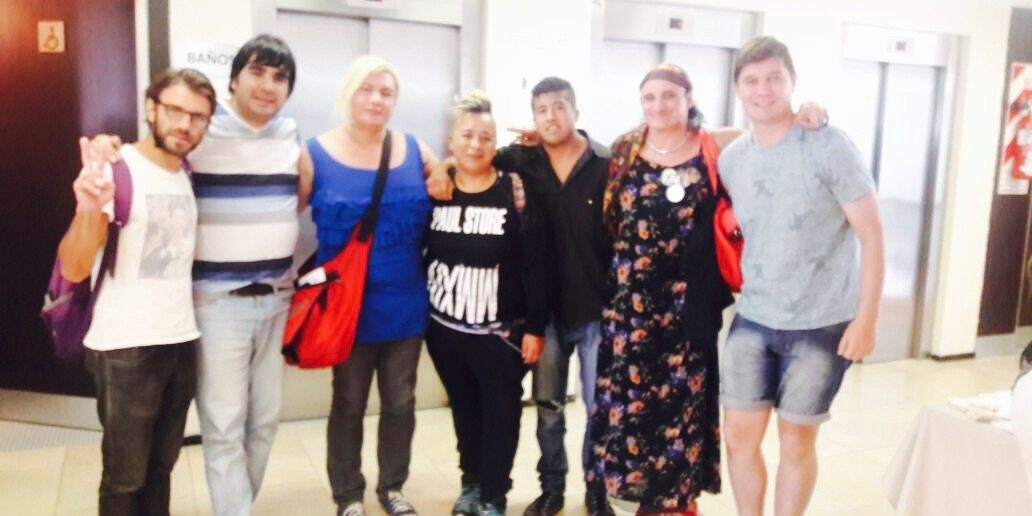
Photos: Courtesy of 100% Diversity and Rights , the Human Rights Secretariat of the Province of Buenos Aires, and Ariel Gutraich. The sexual diversity organizations that supported Diana Sacayán in the fight to guarantee the trans and travesti employment quota are demanding that the Buenos Aires provincial government implement it "urgently." The story of the trans quota law is a story of endless waiting. After the bill languished for years, on September 17, 2015, the Buenos Aires legislature passed it as Law 14,783. This was a month before its author and driving force, Diana Sacayán, leader of the Anti-Discrimination Liberation Movement (MAL), was murdered. Almost a year and a half has passed since its approval. The quota remains unimplemented because the Buenos Aires executive branch has not signed the implementing decree that puts it into effect.
1% of public sector jobs for transvestites, transsexuals and transgender people
The law established a minimum quota of at least 1% of public sector jobs for transgender, transsexual, and gender-diverse people. It was the first initiative of its kind in the world. Furthermore, it represented a turning point in the struggles of this community: it secured state recognition of their right to formal employment, in a context where 98% of them lack it, and nearly 80% are engaged in sex work. [READ ALSO: What's happening with the #TransWorkQuota: a nationwide mapping ]"It is urgent to implement the Trans Employment Quota Law"
“We are at a crucial juncture. We don't want any more meetings; they've dragged this out for far too long. For us, it is urgent that the law be implemented,” Sasha Sacayán, Diana's brother, told this agency. He also recounted that a longtime member of the movement recently passed away from a disease that is now preventable. “She died waiting for a job, waiting for a more dignified life,” Sasha emphasized. On February 1st, officials from the Provincial Human Rights Secretariat informed the dialogue table (which they have maintained with the organizations for a year) that the implementing decree had entered “the final stage” before being signed by Governor María Eugenia Vidal. This took place at a meeting in the Annex of the Provincial Chamber of Deputies. ANDheaded by the Secretary of Human Rights, Santiago CantónThere, the final details for the implementation of the law were finalized. In this regard, reference was made to the creation of a joint commission between the Secretariat of Human Rights and the Ministry of Labor, and a monitoring body composed of representatives from the organizations.
"On the verge of implementation"
“Our plan of constant struggle in the streets, as well as our ongoing complaints to international organizations, have allowed us to reach this moment. To be on the verge of the full implementation of the law,” Darío Arias, coordinator of Conurbanos por la Diversidad, told Presentes. Present She contacted the press office of the Human Rights Secretariat. She asked several times how much longer it would take for the implementing decree to be issued. But the response was that the people handling the matter were traveling for several days. “According to what we’ve been told by the provincial government, we’re in the final stages of the debate on the regulations. We thought that this law, passed with broad consensus in the provincial legislature, would be implemented soon in the province of Buenos Aires. But it took longer than we would have liked,” Karina Nazábal, a legislator from the Front for Victory (FPV) and the driving force behind the bill created by Sacayán in the lower house, told this agency. “This law is a reflection of Diana’s struggle, to provide an answer to the urgent needs of her comrades, her sisters: trans women,” she added.«"Restoring dignity to trans women"
From the early 2000s, Diana Sacayán had a single-minded focus: to lift her fellow trans people out of exclusion and marginalization. Together with Darío Arias, her friend and fellow activist, they traveled throughout the neighborhoods of Buenos Aires province, visiting legislators' offices, universities, and factories. He represented Conurbanos por la Diversidad (Suburban Diversity for the Greater Buenos Aires Area); she, the Movimiento Antidiscriminatorio de Liberación (Anti-Discrimination Liberation Movement, MAL). Over time, they were joined by Abogados por los derechos sexuales (Abosex) (Lawyers for Sexual Rights) and the Asociación de Lucha por la Identidad Travesti Transexual (ALITT) (Association for the Struggle for Transvestite and Transsexual Identity, ALITT). Otrans Argentina and the Asociación por un Mundo Igualitario (AMI) (Association for an Equal World, AMI) also joined the effort. At that time, the LGBTI movement's agenda was focused on marriage equality, and trans issues were relegated to the back burner. Legislators always gave the same response: that other sectors of the population needed more urgent solutions.They are requesting an advisory council to monitor the application.
The organizations asked provincial officials to form a civil society advisory council to monitor implementation. Alessandra Luna, coordinator of the Transvestite and Transgender Front of Greater Buenos Aires for Diversity, explained to Present While they are eagerly awaiting the imminent implementation of the law, they have serious concerns about how it will be applied. “We are living through a very serious situation: because of the closure of brothels, pimps are taking to the streets and systematically chasing trans women. In the midst of this war between pimps…” and "There's the police. An unequal war has broken out for territory because the mafias make deals with the police and reap the benefits. The situation of the trans community is endangered every day, which is why the implementation of the transvestite and transgender employment quota law is urgent," she said. According to a report by the Association for the Struggle for Transvestite and Transsexual Identity (ALITT), the average life expectancy of a trans person is 33 years, and the main causes of death are HIV/AIDS, the injection of industrial silicone (airplane oil), and murder. [READ ALSO: Rosario opened the call for trans workers]
"May it arrive in time for the new generations"
Once the decree is published in the Official Gazette of the Province of Buenos Aires, the next step is to compile a list of job seekers, identify available vacancies, and hire people as needed. “We want to collaborate so that the law is implemented as Diana envisioned it, as she drafted it, and as she championed it. It must be a flawless law, without loopholes or gray areas, and it cannot arrive any later than it is,” said Nazábal. She emphasized the importance of civil society organizations being able to monitor and support its implementation. She added, “We want 2017 to be a year of full rights for a forgotten group, one that has been denied all its rights. This law comes to redress some of that. It arrives late in many lives, in many stories, but we want it to arrive on time for future generations.”We are present
We are committed to journalism that delves into the territories and conducts thorough investigations, combined with new technologies and narrative formats. We want the protagonists, their stories, and their struggles to be present.
SUPPORT US

FOLLOW US
Related notes

We are present
This and other stories are not usually on the media agenda. Together we can bring them to light.
1 Comment