

Argentina: The legacy of Lohana Berkins in a collective exhibition
The exhibition "It's Not the Same. It's Not All the Same," conceived by her friends and fellow activists, opened at the Library of Congress. Activist Marlene Wayar, her niece Ana Carla, and Representatives Juliana di Tullio and Diana Conti were among the speakers who remembered her on an afternoon when everyone's voice broke with emotion.

Share

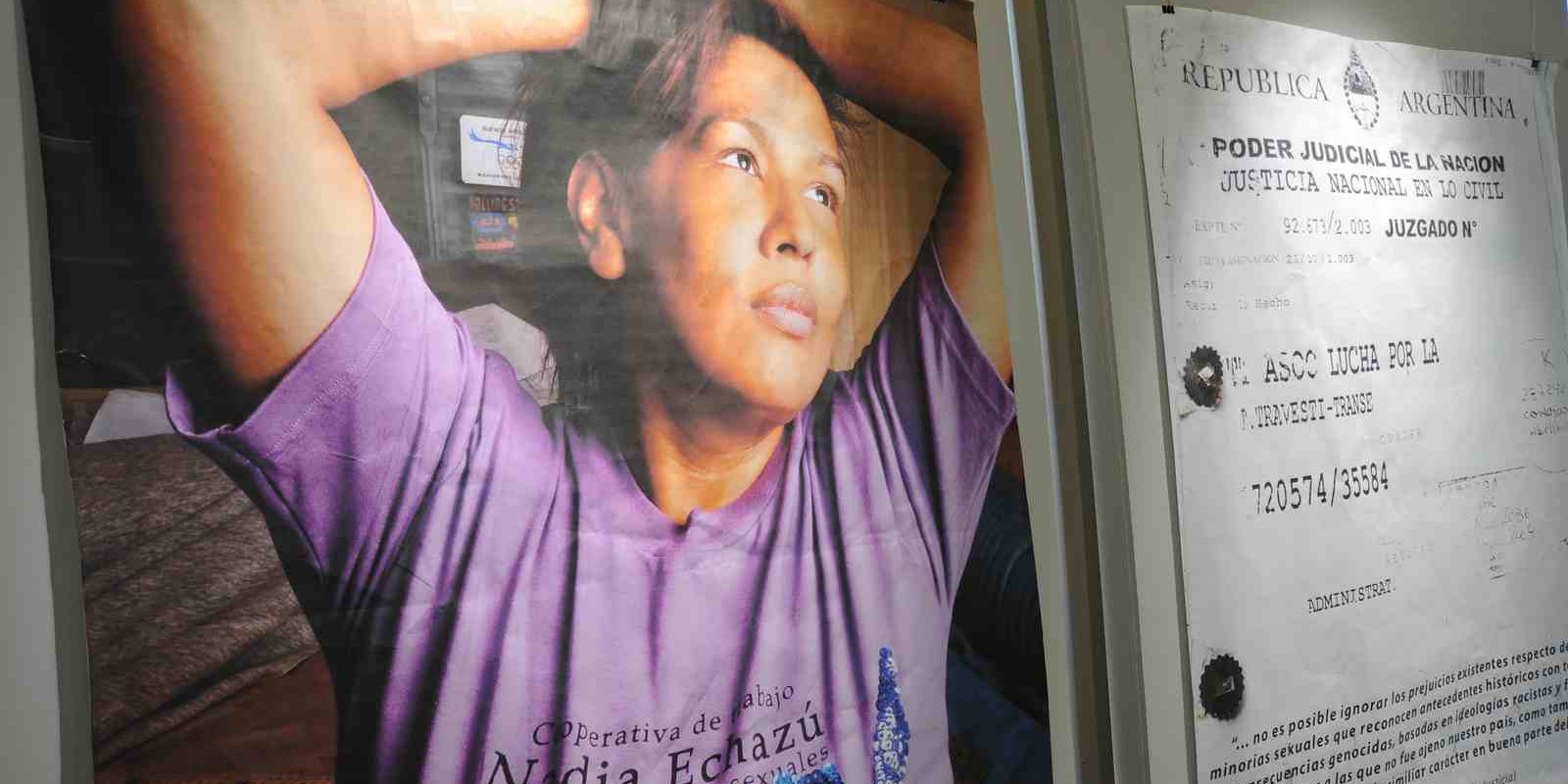
At the Library of Congress, "It's Not the Same. It's Not All the Same" was an exhibition conceived by her friends and fellow activists. Activist Marlene Wayar, her niece Ana Carla, and Representatives Juliana di Tullio and Diana Conti were among the speakers who remembered her on an afternoon where everyone's voice broke with emotion. Photos: Ariel Gutraich. The cultural space of the Library of Congress in Argentina was already packed at the appointed time. More than one hundred people wandered through the space, viewing the photos, videos, quotes, and installations that commemorate the trans activist Lohana Berkins, who passed away on February 5th of last year. "It's Not the Same, It's Not All the Same" is a collective exhibition curated by philosopher Josefina Fernández, coordinator of the Gender and Diversity program at the Public Defender's Office of the City of Buenos Aires. The exhibition, presented by Deputy Teresa García, draws on contributions collected over the past four years and a catalogue with texts by writer María Moreno and journalist Liliana Viola.
[READ ALSO: A year without Lohana Berkins, commander of the Butterflies ]
It's a way to remember her legacy, highlighting her trans and feminist activism and her fight for human rights. But above all, it rescues an intimate, endearing side of a role model who left a deep mark on those who knew her. That's what the speakers emphasized as they remembered her, often interrupted by tears. The artist Susy Shock opened the ceremony singing a cappella and then introduced the words of Congresswoman García. She was followed by the Public Defender of the City of Buenos Aires, Horacio Corti; Ana Carla (Lohana's niece); Graciela Collantes, friend and founder of the abolitionist organization Argentine Women's Association for Human Rights (AMADH); Marlene Wayar; and the congresswomen from the Front for Victory, Diana Conti and Juliana di Tullio, who campaigned alongside her for several of the laws that are her legacy, such as the equal marriage law and the gender identity law. Present It reproduces fragments of his tributes.

[READ ALSO: To provide reparations to trans and transvestite victims of police violence ]
Within that remarkable trans woman who was a pillar of support for so many, there was a little girl who suffered unimaginable things at the hands of a society of indifferent or deeply harmful people. (...) Although the physical body fades, the essence remains. This essence prevails in those of us who once loved her or in those she helped to change. What Lohaba, my Aunt Lohana, Aunt Lohana, left in this world was, quite simply, a legacy. A legacy that shows that a person's identity doesn't have to be imposed by others, since it is something that is built. (...) She helped cultivate the importance of social change. I am grateful to my Aunt Lohana for many things. I am grateful for her affection, her militant and professional example, but mainly for one thing. Something she didn't teach me directly, but which I came to understand through her life. And that is that no matter how broken her wings may have been, it is never too late to try to mend oneself, to help those who cannot mend themselves . And to have the courage to be a butterfly, as she said. May she have bequeathed to us love as the driving force for change, and may the time for revolution be now.”
"Don't worry, from today on we'll be together."
By Graciela Collantes “I met her in 1994, when in the Flores neighborhood, under the Contravention Codes, women who were victims of sexual exploitation or prostitution were systematically taken to jail without any respect for our rights. We began that fight at the end of '94, during one of those raids they carried out at that time, because the police went out to chase us every day. During one of those chases, we saw a patrol car, so we fled into a garage, and in the same place where I was going to hide, there was a person I didn't know. Then she looked at me and said, 'Shhh.' She took my hand, and we both stayed holding hands, holding hands, not breathing because they were looking for us. That night we had our first contact. I was in a very difficult situation. At that time, the city of Buenos Aires was overrun by pimps. The pimp was always walking behind us and had connections with the police stations. So we had no escape. And that person said to me, in two minutes: 'What's your name?' "I'm Lohana, where are you from?" At that moment I was very scared because you couldn't trust anyone. But she told me, "Relax, relax, from today on we'll be together." And from then on we were never apart again.
[READ ALSO: #Argentina: They opened a hair salon to help people leave prostitution ]
We began a fight to confront the police. With the only tools we had at that time, which were our bodies. “We’re not going to jail,” Lohana told us. “And stand your ground, and I don’t want any of you to back down. The first one who backs down will pay.” From then on, she became our guide. She started the fight with the women in Flores. Twenty years passed, everything happened. At that moment, I think she was the right person. I met the right person at the right time.Over these twenty years, many people have joined us in our fight to prevent prostitution from becoming normalized. It cannot be considered a job. “We need public policies, which is what Lohana said. Education policies, housing policies, and prevention efforts. I appreciate the invitation to speak as a voice for the women who were repressed in the 90s. A year has passed since her death, and I still can’t believe it. I’m still waiting for a response, a call. She was the first of us to finish high school. She was a selfless person who taught us without any ego.”

“It is the most immense lotus flower we have as an expression”
By Marlene Wayar "She's in charge. She had the wisdom to know what to do at every moment . How to face what was coming, from her family. How she faced leaving home, finding a trans woman as a surrogate mother in Salta. And facing what she wasn't destined for: prostitution. She ended up in prostitution because she's trans. And from that heartbreak, she begins to build love, to detach herself from the resentment that is endemic to us trans women. We remain in resentment because we are nothing more than unloved children. Who have experienced love because we were born with a cultural assignment that said: 'This one is privileged. This is my boy, he will be my son.' A lot of expectations that disappear when we spread our wings. We know what it is to be loved and we know how cruel heartbreak is. Our situation as trans women is very particular." We were born to be privileged, and by abandoning those privileges we began to touch the filthy depths from which these lotus flowers emerge, like Collantes, like Lohana Berkins, who is the most immense lotus flower we have as an expression .


We are present
We are committed to journalism that delves into the territories and conducts thorough investigations, combined with new technologies and narrative formats. We want the protagonists, their stories, and their struggles to be present.
SUPPORT US

FOLLOW US
Related notes


We are present
This and other stories are not usually on the media agenda. Together we can bring them to light.