

#Argentina: She was attacked for being a lesbian and is now in jail for homicide
Analía de Jesús has been detained since October, when a gang savagely attacked her. "I'm going to make you feel like a woman, you lesbian," one of the attackers told her. They were about to rape her when he stabbed her. The Gender Advocacy Office and social and political organizations denounce irregularities in the case and a lack of access to justice

Share

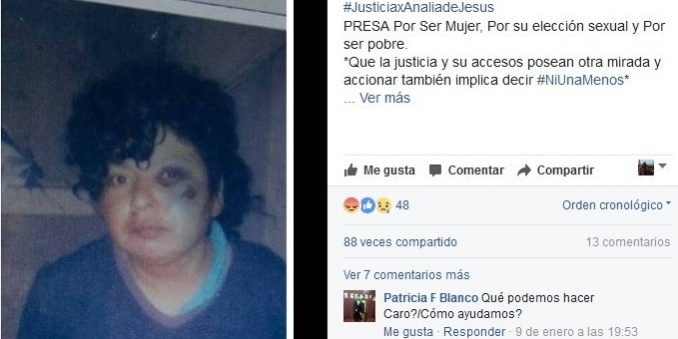
Analía de Jesús has been detained since October, when a gang savagely attacked her. “I’m going to make you feel like a woman, lesbian,” one of the attackers told her. They were about to rape her when she stabbed her. The Gender Advocacy Office and social and political organizations denounce irregularities in the case and a lack of access to justice. By Paula Bistagnino. Photos: Facebook page of Justicia x Higui and Google. (#BUENOSAIRES) — Eva Analía de Jesús has been imprisoned since the night of October 16, accused of stabbing Cristian Rubén Espósito in a house in the Mariló neighborhood of Bella Vista (Buenos Aires province). When police from the Second Precinct arrested her, the 42-year-old woman—"Higui," as she is called by family and neighbors—was almost unconscious and unable to move, with bruises all over her body and her clothes torn to shreds. The next day, in her statement, she said that several men attacked her, kicking her, threatening to rape her, and tore her clothes; that she defended herself as best she could. She also said she was carrying a knife because she had already been attacked in that neighborhood for being a lesbian. But the justice system doesn't consider there to be grounds for self-defense. As the case stands, she could be sentenced to 25 years in prison. “It's a terrible case that highlights homophobia and the lack of access to justice: she was mistreated at every stage, no witnesses were sought, no socio-environmental report was done, her clothing wasn't examined, and she wasn't given a medical examination,” says Carolina Abregú, a representative of the Gender Advocacy Office in Malvinas Argentinas. From there, she managed to bring the case to light a few days ago. The case file currently consists of Analía's only statement—four pages—and those of three witnesses, whom she identifies as the attackers.
Working group for the cause
“I felt like it wasn’t just one of them hitting me, it was two or more, because there were so many kicks, and I wanted them to stop, because I was on the ground, and I got scared when they ripped my pants, because I thought they were going to rape me,” Analía said in the only statement taken from her by prosecutor Germán Muñoz of UFI 25 in Malvinas Argentinas, the following day. To defend herself, she grabbed a knife; she stabbed him in the chest, causing a fatal wound. In recent weeks, social and political organizations—including Pan y Rosas, Folk, the LGBT Defense Office, La Cámpora, the Diversity Department of the municipality of Hurlingham, the Association of Transvestites, Transsexuals, and Transgender People of Argentina (ATTTA), Tortas de Barrio, the Argentine LGBT Federation, Las Fulanas, the MST, and gender advocacy groups—formed a working group to demand justice and support the family, who did not receive legal counsel. The working group wants to understand why the case is in its current state. How did it come about that, despite the evidence, Analía's actions were not considered legitimate self-defense? “The officers at the second police station in San Miguel, who arrested her, didn't take into account what she said. And there's the family's lack of knowledge about how to proceed, their fear of filing a complaint,” Abregú told Presentes."She had been attacked in that neighborhood for being a lesbian."
Analía says she stopped by a friend's house in the Mariló neighborhood, an area of precarious streets and housing on the border of the San Miguel and Moreno districts. She stayed for a while. When she saw that Espósito—her friend's brother-in-law—was there, she decided to leave. She'd had problems with him before; he'd attacked her for being a lesbian. "She was carrying a knife because many years ago she'd been attacked in that neighborhood for being a woman and a lesbian. That time they chased her and stabbed her in the back. And while she was in the hospital getting treatment, they set her house on fire. She had to move," confirms Azucena Díaz, her sister, quoting Analía. She said she carried the knife "out of fear, because the boys are mean and don't like lesbians," and that she had decided not to report the previous attack for fear that something would happen to her sisters and nephews in the neighborhood, so she could defend herself. Analía recounted the attack in her statement: “When I was halfway down the hallway, he grabbed me and said, ‘I’m going to make you feel like a woman, you whore, you lesbian.’ Then he threw me to the ground. Imagine the man’s strength against the woman’s. He kicked me all over my body, and when I saw he was tearing my pants and boxers in the vaginal area, I couldn’t take the kicks anymore. I don’t know where I got the courage, but I pulled out the knife I had between my breasts…” In the following days, several of Espósito’s friends threatened Analía and her family through his Facebook page: “If you don’t pay for this in jail, you’ll pay for it on the outside.” The main witness, Antonio Baso, whom she identifies as one of the attackers, also received threats.
They denounce mistreatment and irregularities
“Higui” had never been arrested. Born in Haedo, the third of eight siblings, she grew up in the northwest of Greater Buenos Aires and had lived for years in Bella Vista, in the San Miguel district. Previously in the Mariló neighborhood—where the latest attack occurred—and now in Barrufaldi, nearby, on the banks of the Reconquista River. “She suffered discrimination her whole life for being a lesbian and poor. That held her back in many ways. She always hustled and worked to survive. Now she made a living gardening, mowing lawns, and collecting cardboard. She gets by; she doesn't have a steady job,” says Azucena, the sixth of the eight siblings and the one who took the lead in the family's fight for justice. “We are poor and uneducated. As soon as this happened, we didn't have any legal advice and we didn't know what to do. Analía was afraid to report it to protect us.” “Another sister and my daughters live in that neighborhood.” Azucena visits her in jail every Friday and has her firsthand account. Supported by the legal team, the sister denounces a series of irregularities: that she was mistreated and degraded both at the San Miguel Second Police Station (where she was held in a cell) and when she gave her statement at 3:30 p.m. the following day—less than 24 hours after the incident and without any assessment of her fitness to speak. In that statement, the sister recounts, Analía was still confused and in pain. Not even the assigned public defender, María Luba Lazarczuk, was present; instead, a legal assistant from the Public Defender's Office was there—as recorded in the minutes. “The public defender is on vacation, and they won't let us hire a lawyer until she returns. My sister has been charged with simple homicide from the very beginning. Self-defense was never mentioned,” Azucena points out.Without medical attention
Another complaint is that Analía, despite the obvious injuries, went a week without medical attention. The day after the incident, when the prosecutor took her statement, a forensic expert saw her. According to Azucena, he only took photos, he didn't examine her. This was despite the defense's urgent request for medical attention to document injuries on her back and evaluate a severe headache. “The prosecutor treated her badly, and besides, he didn't believe her from the start and considered the case closed. He says, like Espósito's family, that she killed him in a betrayal. The police found her unconscious on the ground. If that were the case, who beat her? Who tore her clothes? She was savagely beaten: on her face, head, arms, kidneys, back, buttocks, waist, legs,” says Azucena."Almost closed: simple homicide"
It wasn't until a week later—when she was transferred to the women's detention center in San Martín, where she is being held—that she was taken to the hospital because she had a fever and was still in pain. The forensic examination of her clothing was also never carried out, something the defense had requested on October 17, as recorded in the statement. This information was confirmed by this agency at the UFI 25 (Prosecutor's Office for Investigations) in Malvinas Argentinas. A source with access to the case file admitted that, although evidence and details are still lacking, "this is practically a simple homicide case, because there are no witnesses or information to corroborate Analía's version of events. Everyone says she went looking for him to attack him.".Between six and ten attackers
Although Analía's statement mentions "two or more men," her sister alleges that this is not what she told the prosecutor on October 17th. She claims there were more assailants, between six and ten, but she couldn't count them. "The night they took her to the police station, they made her sign a paper she couldn't read. She only managed to see that it said 'Homicide.' They laughed at her, insulted her, and told her not to make a fuss, that they hadn't done anything to her. Now she's been able to see her statement and says it's not what she said. They didn't advise her. She has no knowledge of laws or rights. It's the first time she's ever been to a police station." Three months have passed since her arrest, and her family says they haven't had any contact with the public defender, Lazarczuk. They went to see her in person at least three times. "We left our address and phone number, but she never contacted us." Only last week was Analía's family able to obtain a copy of the case file. It was through the intervention of organizations and provincial deputy Lucía Portos (La Cámpora), who personally took on the case, that they were able to meet with a substitute public defender who explained the status of the case."Imprisoned for being a woman, poor, and a lesbian"
One of the criticisms leveled at the substitute public defender was that the justice system practically "closed" the case without investigating and that they asked Analía's family to bring them evidence and witnesses. "Do you know what they told us? That they don't have the necessary resources to send people to gather evidence in these kinds of circumstances..." Abregú points out. For her, it's difficult to expect justice when public defenders, prosecutors, and the justice system operate with whatever they find at the time and place. "They didn't look for witnesses, they didn't collect evidence, and they didn't prepare a socio-environmental report. It's shameful and terrible. Every time we have a case like this, it's the same. Because there are so many 'Analías,' all the time, and we want justice for her, of course, but we also want it to serve to bring visibility to what happens to a poor, lesbian woman; conditioned first by society and then by institutions.". Follow Presentes: Twitter @PresentesTLGBI Instagram: PresentesTLGBI Facebook: https://web.facebook.com/presentesTLGBI/ ]]>We are present
We are committed to journalism that delves into the territories and conducts thorough investigations, combined with new technologies and narrative formats. We want the protagonists, their stories, and their struggles to be present.
SUPPORT US

FOLLOW US
Related notes

We are present
This and other stories are not usually on the media agenda. Together we can bring them to light.