

#Argentina: progress and shortcomings of the trans employment quota
The transgender employment quota law in the province of Buenos Aires, championed by activist Diana Sacayán, was passed in 2015 but still lacks implementing regulations. At the national level, several bills are currently before Congress. So far, municipalities are leading the way, with ordinances passed in 13 localities. At the provincial level, Salta, Entre Ríos, and Corrientes are closest to enacting a law that guarantees a basic right: employment.

Share

The transgender employment quota law in the province of Buenos Aires, championed by activist Diana Sacayán, remains unenforced. At the national level, several bills are currently before Congress. So far, municipalities have taken the lead, with ordinances passed in 24 localities. At the provincial level, Salta, Entre Ríos, and Corrientes are closest to enacting a law that guarantees a basic right: employment.
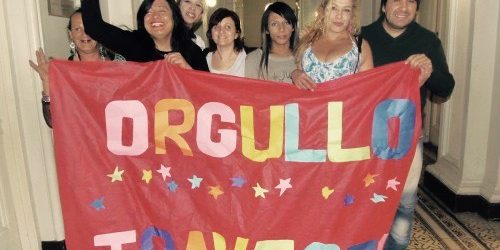
[NEWS UPDATED 9/17/2017] Photos: Courtesy of 100 por Ciento Diversidad and Archivo de Presentes (#BUENOSAIRES) — In early 2000, Diana Sacayán knew that the transsexual, transvestite, and transgender community needed to secure the passage of a job quota law to lift them out of the exclusion and marginalization they faced. “Faggot, you’re crazy,” recalls Florencia Guimaraes of Furia Trava, saying every time she insisted. She didn’t care. With Darío Arias, her friend and fellow activist, they traveled to neighborhoods throughout the Province of Buenos Aires, visiting legislators’ offices, universities, and even factories. He represented Conurbanos por la Diversidad (Suburbanites for Diversity); she represented the Movimiento Antidiscriminatorio de Liberación (Anti-Discrimination Liberation Movement, MAL).
They were soon joined by Lawyers for Sexual Rights (Abosex) and the Association for the Struggle for Transvestite and Transsexual Identity (ALITT). At that time, “the LGBTI movement’s agenda was focused on marriage equality, and trans issues were relegated to the back burner,” explains Arias. Meanwhile, in the provincial legislature, they always repeated the same thing: no, discrimination would never allow such a law, and there were other sectors of the population that needed more urgent answers.
[READ ALSO: #Argentina: Mocha Celis trans high school opens its summer courses ]
In December 2009, Karina Nazábal, a deputy from the Front for Victory (FPV), took office as the first representative to support the cause. After several attempts over six years, on September 17, 2015, the organizations finally achieved the passage of Law 14.783, the Transgender Employment Quota Law , which mandates that the Province of Buenos Aires employ transvestite, transsexual, and transgender people in at least 1% of its workforce. It was the first time such a demand had been met in the world. A month after the law's approval, Diana Sacayán was brutally murdered. Today, a bill has passed one house of Congress to include her name in the legislation. "Ten years ago, it seemed impossible, and yet she believed it was possible. For us, naming the law after Diana Sacayán is also an act of justice," says Arias.
Leading the way on the LGBTI agenda
The passage of the Diana Sacayán Law was a turning point in the struggles of the transvestite, transsexual, and transgender community because it secured state recognition of their right to formal employment, in a context where 98% of them earn their income through prostitution. This led to a surge of projects with increasingly broader scope reaching municipalities, provinces, and the national government. “It was so momentous because it not only guarantees a right for a group, but it also placed access to employment for transvestite and trans people among the priorities of the LGBTI movement,” explains Arias. A law cannot change the entire reality of trans people overnight, although it can do a great deal. “If even one of our sisters gets a job, it’s a huge victory for us because we are burying sisters every day. It’s a debt the state owes us for having been complicit in our life expectancy of only 35 years,” says Guimaraes. 
The regulations that never arrive
Twenty-one months have passed, and the law still hasn't been regulated, and therefore, hasn't been implemented. Sources within the governor's office assured that "the regulations are imminent." This was communicated to social organizations "who still have unmet expectations," Arias points out. "Every day that passes is another day that a comrade goes out onto the street corner not knowing if she'll make it home or if the police or some guy will beat her to death," Guimaraes adds. The context for the regulations is also one of an increasingly adverse political climate for the LGBTQ+ community, "which means that these kinds of initiatives aren't considered important, but rather as victories and advances that need to be undone," Arias indicates, adding that "Morón and Lanús, the only municipalities in the Province that had comprehensive diversity policies, discontinued them."
[READ ALSO: #TransWorkQuota What's happening with the law in the province of Buenos Aires? ]
With Mauricio Macri's assumption of the presidency and the wave of mass layoffs in early 2016, one case gained such prominence that it culminated in a court ruling against the state. Valentina Pereyra worked at the Comprehensive Center for Women Victims of Violence in La Plata when she was dismissed by the new provincial administration. Judge María Ventura Martínez, head of the Administrative Litigation Court No. 4, ordered her reinstatement , citing, among other things, the municipality's non-compliance with the provincial quota law. However, a few days ago, the La Plata Court of Appeals for Administrative Litigation overturned the injunction . Thanks to this support and pressure, on February 1st, officials from the Provincial Secretariat of Human Rights informed the dialogue table (which they have maintained with organizations for a year) that the implementing decree had entered its "final stage" before being signed by Governor María Eugenia Vidal. It was at a meeting in the Annex of the Provincial Chamber of Deputies. “We are at a crucial juncture; we don't want any more meetings. They've dragged this out for far too long. For us, it is urgent that the law be implemented,” Sasha Sacayán, Diana's brother, told this agency. He also recounted that a longtime member of the movement recently passed away from a disease that is now preventable. “She died waiting for a job, waiting for a more dignified life,” Sasha emphasized.
Greater Buenos Aires
- In Avellaneda, Lanús, Morón, Almirante Brown, Merlo, Tres de Febrero, and San Miguel, the city councils approved adherence to the Diana Sacayán Law. The proposals were presented by Conurbanos por la Diversidad (Suburban Diversity), the Movimiento Antidiscriminatorio de Liberación (MAL) (Anti-Discrimination Liberation Movement), and the Mocha Celis High School, through council members of the Frente para la Victoria (FPV) (Front for Victory).
- It was also approved in the towns of Azul and Chivilcoy - both initiatives were presented by ATTTA - and in Campana.
- Projects were submitted in Lomas de Zamora, Quilmes, Hurlingham, La Matanza, Esteban Echeverría, Moreno, Florencio Varela and Ituizangó, but they have not been approved.
- In the city of La Plata, an emergency law was passed regarding the quota. "It's not technically a trans quota, but it's a virtual agreement," explained representatives from Conurbanos por la Diversidad (Greater Buenos Aires for Diversity).
Mar del Plata
In March 2017, a groundbreaking resolution in the national and regional academic sphere—promoted by the Lohana Berkins Chair—guaranteed 1% of the non-teaching positions at the National University of Mar del Plata for transgender, transsexual, and gender-diverse individuals. Thirty applicants registered.

Projects towards a national law
The challenge now is passing a national law that can be applied in all jurisdictions. Several bills are currently under consideration.
- In May 2016, FALGBT and ATTTA presented a Comprehensive Bill for Transgender People that, among other points, includes a 0.5 percent job quota in public employment, plus a tax incentive for private employers. It was presented with the signatures of legislators from the FPV-PJ, the Socialist Party, UNA, Proyecto Sur, and Peronismo para la Victoria. But there are also other specific provisions.
- In May, the Workers' Left Front also presented a bill establishing a quota of no less than 3%. In June, the Civic Coalition-ARI (CC-ARI) presented the Lohana Berkins Labor Quota Bill , which stipulates a percentage no lower than 1%. In July, another bill was added, signed by legislators from the Front for Victory in Córdoba, Buenos Aires, Misiones, Tucumán, Entre Ríos, Chaco, Catamarca, and Santa Fe. This bill sets the percentage at 3% and also establishes the possibility of deducting a portion of social security contributions as a VAT tax credit for the private sector. Legislators from this party in Chubut, Neuquén, Río Negro, Chaco, and Santa Cruz presented one in October , and another, signed by a single party, was presented in Buenos Aires . Finally, in September 2015, the Civic Front of Santiago del Estero had already submitted one .
Buenos Aires City: a law "by mistake" that guarantees trans labor inclusion
Drafted by the deputies of the Front for Victory Carlos Tomada and Pablo Ferreyra, together with Maximiliano Ferraro, of the Civic Coalition – ARI, in September 2016 a new bill for trans labor quota , based on the agreements reached for previous projects that lost parliamentary status, by the then legislators María Rachid, Daniel Lipoveztky and Ferraro himself.
Although it is signed by at least 25 legislators from nine different blocs, its progress is stalled by the lack of support from the Pro bloc, which holds a parliamentary majority.
Paula Arraigada began working in the Buenos Aires City Legislature as an advisor to Representative Gabriel Fuks—currently with the National Militancy Movement—when she was just over forty years old. As she recounts this, her calm yet firm and confident voice pauses. “I was an outcast for many years. I came to Buenos Aires from Entre Ríos, where I studied to become a teacher, thinking I could teach here, but I never was.” She barely scraped by, relying on odd jobs and the sex work she endured. “I never had a salary, health insurance, or the opportunity to see myself as I do today, more grounded, understanding that I am also part of a society that is somewhat better off than it was ten years ago when we didn't even have the right to call each other by the names we knew,” she says.
[READ ALSO: “We need to assemble the genome of trans people” ]
The bill is being promoted by the Florida Front, Self-Organized Trans People of the Argentine Republic, Peronist Queers, Popular Diversity The Current, Trans Friends, The Martín Fierro Current, Positive Diverse Network, Trans Art, Trans Women of Argentina, La Cámpora Diversia, and La Néstor Kirchner (Tucumán). The City also has a precedent, albeit "by mistake." As part of a broader project on public policy guidelines for the recognition and full exercise of citizenship for lesbian, gay, bisexual, trans, and intersex people, drafted by Maximiliano Ferraro himself, the Buenos Aires City Legislature discussed trans employment inclusion, but due to pressure from the PRO party, the article was omitted. However, on the day of the vote, a version of the previous bill that still included it was approved—by mistake. Thus, since 2012, there has been a Buenos Aires City law that, while not creating a quota, does urge the Executive Branch to guarantee trans employment inclusion .
Santa Fe
It took two years of knocking on doors, requesting meetings, and building consensus until the very last minute, until Rosario became the first municipality to approve an ordinance establishing a trans job quota This was based on projects from the Diversity Front of the Evita Movement and Putos Peronistas Rosario, along with another proposal from Vox Civil Association. In January of this year, registration opened for the first time so that interested individuals could sign up. Registration closed in March with 62 people registered , and after a selection process, five will be chosen . “Today, a trans person trying to plan their future didn't have the possibility of thinking about formal employment, and this allows them to dream. Here, they're not just thinking about what they're going to eat tomorrow, but about being able to dream about other things,” Michelle Mendoza, one of the project's promoters, told Enredando at the time . The project was voted in favor by the Socialist, FPV, Justicialist Party, Ciudad Futura, Radical, and Radical Civic Union (UCR) blocs. Progressive Radicals, UCR 1983, United and Organized-FPV, Commitment to Rosario, Rosario Federal, Civic Coalition-ARI, Progressive Democratic Party, Social Progress Party, Social and Popular Front and Solidarity Peronism, with the sole abstention of the PRO Federal Union.
[READ ALSO: Rosario opens the call for trans workers ]
The Undersecretary for Sexual Diversity of the province of Santa Fe and Vice President of the Argentine LGBT Federation (FALGBT), Esteban Paulón, told Presentes that at the provincial level, the Labor Affairs Committee issued a favorable opinion on the quota yesterday. The next step is its joint review by the Constitutional Affairs and Budget Committees before being debated in the legislature. The consensus was reached based on the three existing bills: one presented by FPV legislator Leandro Busatto, another by the Social and Popular Front under the signature of Representative Carlos del Frade, and a final one promoted by Equality and Participation legislators Silvia Augsburger and Rubén Giustiniani. In the last session of its Deliberative Council, the municipality of Las Heras in Mendoza approved a 0.5% quota for municipal employment, which includes the creation of training programs for those who do not meet the qualification requirements for public sector jobs. “Now comes the implementation phase, but this isn’t a new issue because there are already transgender people working in the municipality,” Karina Ferraris, a councilwoman and the project’s driving force, told this agency. On March 29, Venado Tuerto unanimously approved a transgender employment quota. It was the second city in Santa Fe province to have one, after Rosario . The quota provides for the hiring of five transgender people by the municipal staff to perform various tasks.
[READ ALSO: The trans job quota has incorporated its first worker in Venado Tuerto]
Cordova
As in Santa Fe and Mendoza, the municipality of Bell Ville in Córdoba province is the first in the province to approve an ordinance establishing a 0.5% job quota for transgender people in public employment and incentives for private employers. Furthermore, on July 15, 2016, exactly six years after the passage of the equal marriage law, the organization Devenir Diverse presented a draft ordinance to the Córdoba City Council promoting formal employment for transgender people . At the provincial level, legislators Ezequiel Peressini and Eduardo Salas of the Workers' Left Front (FIT), along with Soher El Sukaria of the Republican Proposal (PRO), presented a job quota bill for transgender people in May of this year. In 2013, the FIT and the Civic Front had already presented a bill that is still pending in the legislature, according to the official website of the Córdoba Legislature.
The Pampas
In Santa Rosa, the "Trans Employment Quota" ordinance was approved in June 2017 by the City Council's Administrative and Regulations Committee. The project was presented on April 21 by Councilor Alba Fernández, making viable the initiative of the Trans collectives and "Todas Somos Andrea" (We Are All Andrea), activists for the advancement of equal rights and sexual diversity. It proposes a minimum of 1% for transvestite, transsexual, and transgender people employed by the Municipality. In November 2016, Eduardo Tindiglia, a provincial deputy from Nuevo Encuentro, presented a bill for a trans employment quota , along with local organizations and the Frente Pampeano para la Victoria (La Pampa Front for Victory) team. "This project is promoting policies of equal opportunities and rights in the public sector. All three branches of government, decentralized agencies, and state-owned companies would be required to employ trans people in a quota of no less than 1 percent," Tindiglia explained during the presentation.
Jump
This province is closest to passing another transgender employment quota law . After receiving preliminary approval in the Chamber of Deputies, the bill, introduced in November 2015 by the transgender community, was approved with modifications by the Senate and must now return to the Chamber of Deputies for final approval. While it originally established a 3% quota, it was reduced to 0.5% during the legislative process, representing approximately 350 public sector jobs.
Entre Ríos
bill creating the Provincial Area of Gender Identity and Sexual Diversity Policies received preliminary approval The initiative, approved in the Chamber of Deputies, is the result of merging two bills, one from Deputy Emilce Pross (FPV) and the other from Deputy Gabriela Lena (Cambiemos), supported by the work of the organizations MISER, Aquelarre Diversidad, the Gender, Human Rights and Health Program of UADER, and Las Capitanas. The area will be staffed by transgender people. In Gualeguaychú, a job club for transgender youth was launched, a program funded by the World Bank to seek collective solutions for comprehensive job placement. It offers support and training to transgender people so they can seek and find employment or develop their own projects in both the public and private sectors.
Jujuy
In April, Radical Party congresswoman Gladys Méndez introduced a bill that will be reviewed by the Labor, Social Security, Human Rights, and Finance committees. It proposes a quota of no less than 1 percent for women in the public administration.
Chaco
Resistencia, the capital of Chaco province, is another city that, at the end of September this year, approved its own ordinance to guarantee the employment of transgender people, based on a project presented by councilwoman Nancy Sotelo of the Libres del Sur Movement. In an interview with Radio Libertad, Úrsula Sabarese ), celebrated the passage of the ordinance and emphasized that “the goal is to give people the dignity of being able to have a job and thus access housing, healthcare, and the opportunity to continue improving themselves, like any other citizen.” At the provincial level, legislator Daniel Trabalón of the Frente Grande party presented a similar bill in 2014.
Currents
At the end of November, the Congress of the province of Corrientes gave preliminary approval to a job quota bill presented by FPV Senator María Inés Fagetti, which promotes "real equality of opportunity in public employment for transvestite, transsexual and transgender people".
Chubut
With the support of ATTTA and FALGBT, Representatives Gustavo Fita and David González of the Front for Victory party introduced a bill in October to ensure that transgender people occupy at least one percent of all jobs in local public administration. The initiative includes "the creation of a training and development system to ensure they meet the necessary qualifications for employment, where required."
Rioja
bill for a trans employment quota was presented, signed by provincial deputy Marta Isabel Salinas and promoted by the Diverse LGBTIQ Community Association and the Municipal Directorate of Diversity of La Rioja.
Mendoza
In Luján de Cuyo, an ordinance was enacted in August 2017 incorporating a 1.5% quota for transgender, transvestite, or transgender workers into the municipal workforce. "The project was drafted by leaders of the trans community, such as Antonela Espinoza and Beatriz Evelyn Silva, and presented by councilors Facundo Terra and Nicolás Córdoba of the Left Front. Now, the Municipal Executive Branch must regulate it and then begin the implementation process," said Valentina Daniela Ochoa (Agrupación 1969 LGBTI Mendoza). In the Las Heras Department, a similar measure was approved by resolution. The project, presented by councilor Karina Ferraris of the Libres del Sur bloc, establishes that a 0.5% quota of municipal jobs must be granted to transgender, transvestite, and transsexual people. "At the provincial level, a trans job quota project was presented, but it did not have the necessary momentum and lost its parliamentary status," Mario Vargas of the Liberation Equality for Change movement told Presentes.
Neuquén
In November 2012, the Neuquén National Roundtable for Equality, the Association of Transvestites, Transsexuals, and Transgender People of Argentina (ATTTA Neuquén), the Conciencia Vihda Association, the Lesbian Entrepreneurial Movement, the Argentine Federation of Lesbians, Gays, Bisexuals, and Trans, and members of the provincial legislature from various political parties presented a bill for a trans employment quota in the provincial legislature. Although it was discussed in the Labor Legislation and Employment Affairs Committee, the bill did not pass. “After so many referrals to committees, it’s still an outstanding issue,” Ornella Infante, coordinator for the Patagonia region of ATTTA and head of the Río Negro branch of the Evita Movement, told this agency. “I think it has to do with ignorance on the subject, a lack of sensitivity, but also a lack of political will,” she added. The Workers' Left Front, through Deputy Angélica Lagunas, presented another labor inclusion project at the end of 2014 , although it also did not advance.
Rio Negro
In early December, Jorge Vallazza, a legislator from the Front for Victory, presented a bill The proposal calls for the creation of a 2% job quota in the public administration. “Work is a fundamental human right that must be guaranteed by the State, with the participation of civil society, to the entire population, and in particular to groups marginalized from the formal labor market, such as transgender people,” the bill states. In Viedma he went toAn ordinance, promoted by Mariana Arregui (Socialist Party), Evelyn Rousiot (FpV), and Silbana Cullumilla (FpV), was approved in December 2016 by the Viedma City Council. Following pressure from social movements such as the Viedma-Patagones LGBTQ Collective, supported by the feminist group Mujeres Organizadas-La Comarca, two transgender people began working. The six vacancies have not yet been filled, and the ordinance still needs to be implemented.
Santiago del Estero
With the support of local organizations, the legislator of the Radical Civic Union, Marcelo Lugones, presented a bill for access to formal work for trans people .
Tucumán
In its last session of 2016, the Tafí Viejo City Council approved a trans employment quota ordinance, promoted by ATTTA, which mandates the incorporation of one percent of trans people into the local administration. At the provincial level, a bill proposing a quota of no less than one percent in the public administration and a reduction in the gross income tax for private companies that employ transvestite, transsexual, and transgender people in at least two percent of their total workforce.
Saint Louis
Gema Rosales, representative of ATTTA San Luis, explained to Presentes that with the reopening of the legislative year in February 2017 they will present a job quota bill that they already have prepared.
Saint John
There is still no bill, but the province's Human Rights Secretariat is pushing for agreements with legislators to approve the quota in San Juan, as Verónica Araya, an activist with ATTTA, told Presentes . In this context, local organizations are demanding to be included in the debates. 
Missions
In November, Collective 108 submitted a Transgender Employment Quota bill to the Chamber's front desk. This organization also worked on a new bill for transgender employment inclusion. Through Representative Miriam Duarte, this collaboratively developed bill has already been submitted to the Chamber and is now under parliamentary consideration. In the city of Posadas, they are working with Councilor Natalia Giménez on presenting a similar transgender employment inclusion bill.
Catamarca
During the last week of November, activists from ATTTA marched to the Government House to demand a meeting and a discussion on transgender employment inclusion. However, no bills have yet been introduced in the provincial legislature.
Formosa
There is currently no bill. Through ATTTA, the trans community is working with provincial ministries to develop training programs and courses that will enable the creation of micro-enterprises. “Today we are coordinating with the Minister of Government of Formosa, Jorge González, to work next year on the first cooperatives for the trans community,” Xiomara Chavez, a representative of ATTTA, explained to this agency.
Santa Cruz
In October, a project for the inclusion of trans people within the public administration was presented, authored by legislator Gabriela Peralta, of the PJ.
Tierra del Fuego
In June 2017 The trans job quota for the Municipality of Río Grande was approvedTransgender people will occupy 0.5% of the municipality's jobs. The measure was approved after weeks of debate that included input from political and social organizations such as the Ni Una Menos collective and the feminist movement La Ría, as well as institutions like the National University of Tierra del Fuego.
We are present
We are committed to journalism that delves into the territories and conducts thorough investigations, combined with new technologies and narrative formats. We want the protagonists, their stories, and their struggles to be present.
SUPPORT US

FOLLOW US
Related notes

We are present
This and other stories are not usually on the media agenda. Together we can bring them to light.