

#Argentina: drastic increase in transvesticides in 2016
The country still lacks an official observatory for victims of hate crimes based on gender identity. Figures collected by various organizations in 2016 indicate at least 16 transphobic murders: more than the total number of hate crimes against LGBTQ+ people reported in 2015 in the report by the Argentine Homosexual Community (CHA).

Share

The country still lacks an official observatory for victims of hate crimes based on gender identity. Figures collected by various organizations in 2016 indicate at least 16 transphobic murders: more than the total number of hate crimes against LGBTQ+ people reported in the 2015 report by the Argentine Homosexual Community (CHA). By Carolina Rosales Zeiger Photos: Ariel Gutraich and archive Presentes (#BUENOSAIRES) — Sofía was found on Monday, murdered with a blow to the head, in an abandoned lot in Mercedes. Erika was 29 years old. Zoe, 36. Evelyn had just turned 26, and her lifeless image went viral on social media. They were trans people and were murdered in 2016. It is estimated that at least 16 transphobic murders/transfemicides were recorded this year. The average life expectancy of trans and gender-diverse people does not exceed 40 years, according to various studies on this population. Of the 13 hate crimes documented in the 2015 annual report of the Argentine Homosexual Community (CHA) (based on media reports), six were against transvestite or transgender people. But this year's number of transvesticides surpasses even the total number of hate crimes from last year.

"They kill us and our deaths go unchallenged"
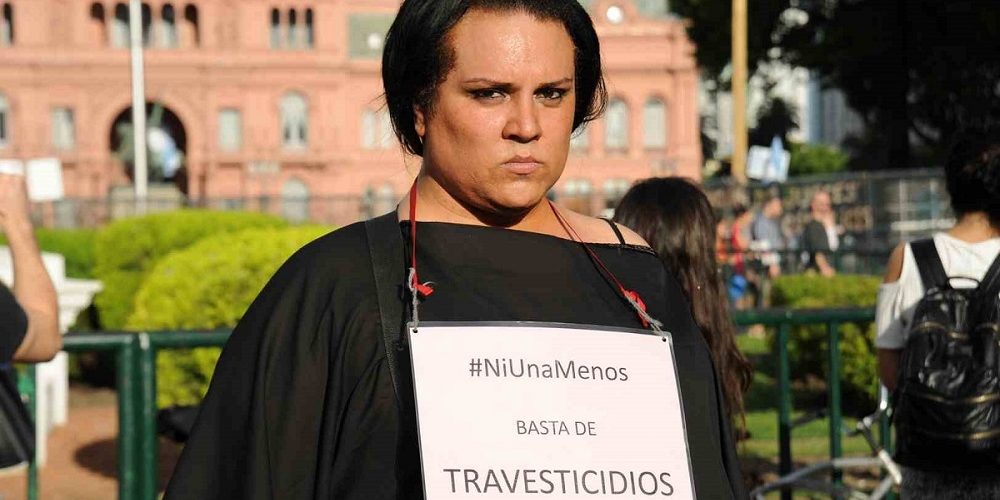
According to the collaborative map of trans violence (where activist Paula Salinas compiles data that anyone can contribute) In 2016, at least 11 trans and travesti people were murdered. This number is consistent with the figures from the Adriana Marisel Zambrano Observatory of Femicides in Argentina, coordinated by La Casa del Encuentro, and the Observatory of Women of the Latin American Motherland (MuMaLá). They only make brief clarifications within their reports on femicides in general: the organizations that are carrying out the first specific reports on crimes based on gender identity—the Argentine Federation of Lesbians, Gays, Bisexuals and Trans (FALGBT), the Association of Transvestites, Transsexuals and Transgender People of Argentina (ATTTA), the Ombudsman's Office, and OTRANS—estimate that the number of reported cases could be at least double and could even approach triple. The escalation of violence prompted a "Gritazo" (shout) on November 24th in Plaza de Mayo, where a group of LGBTI organizations... They declared a state of emergency for the group due to the systematic and increasing violence against them.They formed a circle around the Pyramid and, emulating a historic struggle of Mothers and Grandmothers, demanded: Stop the murders of trans people. "Transvestites and trans people are killed, and our deaths don't challenge the status quo, nor are they a reason to demand justice like others. For society and for the State, our death, as well as our life, is worthless; it's not a life worthy of being lived under equal conditions, like the life of any ordinary citizen. We need homes, jobs, health, education, and reparations, and for that, of course... WE NEED TO BE ALIVE," read the document that the organizing associations read that day.
With violence and cruelty
Bella Inostroza, 40, was found dead on January 17 in General Roca, Río Negro. Her body was lying in an irrigation ditch, showing signs of violence and a gunshot wound to the head. The crime was classified as simple homicide, and to this day, no one has been charged. Erika Rojas disappeared on April 1. She was found 20 days later in the Formosa industrial park: she had been burned, as had her belongings. No one has been charged in her murder. Jose Zalazar Maturano was a cleaning worker at the Casa del Niño y del Adolescente (Children's and Adolescents' Home) in La Boca. She was found dead on February 22 in Florencio Varela, in the southern part of Greater Buenos Aires. She was naked, with blows to her head and body, and her face was slashed. No one has been charged in her murder either. Zoe Quispe, a member of the "Iron Ladies" organization in Jujuy, was murdered by her partner on September 10, stabbed 36 times. Even today, the prosecution continues to frame its investigations as "double aggravated homicide due to the familial relationship and cruelty or treachery," and not as a hate crime. The case of Evelyn Rojas in Misiones caused only slightly more of a stir when photos of her lifeless body circulated on social media. Evelyn was attacked, beaten repeatedly in the face with a blunt object. When she was found at an abandoned gas station in Posadas, she was partially undressed and her face was disfigured. Estrella Belén Sánchez was 26 years old and died on November 16 at the Córdoba Emergency Hospital from cardiac arrest, a consequence of the injuries inflicted on her body. The courts are investigating the occupants of a 4x4 vehicle with whom the victim is suspected of having met hours before she was murdered.
More institutional violence in Buenos Aires, San Juan and Jujuy
All this data was collected from social media and news outlets: Argentina still lacks an official observatory for victims of hate crimes based on gender identity. The Argentine LGBT Federation (FALGBT) announced in May of this year the launch of a report for 2017. They will work in conjunction with the Association of Transvestites, Transsexuals, and Transgender People of Argentina (ATTTA) and the National Ombudsman's Office. The report will be titled "Waiting for Death," as Marcela Romero, president of ATTTA and FALGBT, told Presentes. She explained: "We have counted at least 14 cases. There has also been an increase in institutional violence, especially in the provinces of Buenos Aires, San Juan, and Jujuy." In 2012, the National Institute of Statistics and Censuses (INDEC) conducted the First Survey on the Trans and Travesti Population, which recorded that 83% of this population had been victims of serious acts of violence and police discrimination. In its annual report, the Convention on the Elimination of All Forms of Discrimination against Women (CEDAW), after receiving a report from several organizations on the situation of trans and travesti people in Argentina, emphasized the need to generate statistics on these crimes. For example, reports of police harassment and the deaths of activists. Furthermore, it demanded that the Argentine government adopt programs to promote access to decent work for this population. According to the president of ATTTA, the past year has shown figures indicating a worrying and significant increase in violence against the trans community. “In areas like Route 8 and Márquez, Camino de Cintura, our comrades are being arrested every day. They're looking for bribes. That didn't happen a year ago,” she said. She added that the change in government also meant a change in the way the Security Forces operate. For Romero, the State's “directive policy” is now “repressive and violent.”
"The security forces do whatever they want."
For Esteban Paulón, vice president of FALGBT and executive president of the Red Gay Latino, the increase in institutional violence is also evident, although the State's response is characterized by omission in terms of management and public policies. "There is an increase in institutional violence; the Security Forces do whatever they want," he stated in an interview with PresentPaulón believes that rather than a targeted policy, the new administration is giving free rein to the police and security forces to act with impunity and without any regulation. “The Gender Identity Law was incorporated, but there have been no further public policies since,” Paulón denounces. She emphasizes, “In the provinces, there is no healthcare service, even though the law has been regulated. There is still resistance and delays due to ideological, budgetary, and priority reasons.” Following the approval of the Gender Identity Law in 2012 and its subsequent regulations, organizations and activists continue to denounce the lack of budget and political will to achieve its full implementation. “There is neither budget nor political will,” Romero stated. For her, the issue of the employment quota is currently a “smokescreen,” and what is needed now is “historical reparations.” Claudia Vasquez Haro, president of Otrans Argentina, opined that in terms of public policies by the State, “there is an absence, an indifference, and also a lack of awareness.” She added: “We have been denouncing to the National Council of Women (CNM) the lack of a comprehensive policy, for example, for trans women experiencing homelessness.” Otrans estimates “around 20 cases (of transphobic murders) in 2016.” “In October alone there were 3 transphobic murders; there is an increase, and that is why we are concerned.” For Vasquez, the increase in violence is directly related to the change in government: “The right wing in power enables stigmatizing and reductionist discourses that reinforce the status quo and heteropatriarchy. They are the ones who allow Monsignor Aguer to ask Macri to repeal the Gender Identity Law; they are the ones in Mar del Plata with the neo-Nazi groups that attack gay youth. It is a profoundly conservative ideology that ends up fueling hatred toward our diverse identities, which translates into hate crimes, transvesticide, and transfemicide.” Vasquez agrees that institutional violence has worsened in the last 11 months and emphasizes the need for a comprehensive policy, “with a direct action team, with lawyers and trained and sensitized personnel, with a psychologist to support you in these situations, and with coordination with SEDRONAR (Secretariat for Programming for the Prevention of Drug Addiction and the Fight against Drug Trafficking) to treat addictions.” In this regard, she denounced: “The 144 hotline (designed to provide information, guidance, advice, and support to women experiencing violence throughout the country, 24 hours a day, 365 days a year) is no longer operating. And if it is, the person answering is untrained. At the Women's Council, you call and they don't answer, they don't coordinate, they tell you they're overwhelmed, that it's beyond their control, and they imply they lack the budget.”
Global concern
In 2014, the Inter-American Commission on Human Rights (IACHR) recorded 594 LGBT murders. When compiling this data, the IACHR noted “the difficulty in determining the sexual orientation or gender identity of the victims because information sources, and especially journalistic sources, rarely take into account the victims' self-identification.” The report prepared by the Trans Murder Monitoring Project of the organization Transgender Europe (TGEU), released in March 2016, documented at least 2,016 murders of trans and gender-diverse people in 65 countries worldwide between 2008 and 2015. South and Central America accounted for 1,500 of these murders. Sixty-five percent of the victims were sex workers. Many organizations and activists are now promoting the use of the acronym LGBTQI+, which encompasses sexual diversity. It is a way of raising awareness: transvestite and trans people today are going through a situation of extreme vulnerability. In July, the United Nations (UN) Human Rights Council adopted the resolution “Protection against violence and discrimination based on sexual orientation and gender identityThe UN General Assembly, which created the position of an independent expert on sexual orientation and gender identity (SOGI) with a three-year mandate, saw a group of African countries attempt to halt the appointment in December. However, the UN General Assembly secured the necessary votes a week ago to maintain the appointment. Renato Sabbadini, Executive Director of the International Lesbian, Gay, Bisexual, Trans and Intersex Association (ILGA), stated: “We are confident that the SOGI Independent Expert will build bridges, rather than widen existing divides within our communities and between those individuals or states who believe we are seeking ‘special rights.’ Now more than ever, our communities need allies to ensure that ‘all human beings are born free and equal in dignity and rights,’ as affirmed in the Universal Declaration of Human Rights, which is a reality, not just a dream.”
Follow Presentes:
Twitter @PresentesTLGBI Instagram: PresentesTLGBI Facebook: https://web.facebook.com/presentesTLGBI/ ]]>We are present
We are committed to journalism that delves into the territories and conducts thorough investigations, combined with new technologies and narrative formats. We want the protagonists, their stories, and their struggles to be present.
SUPPORT US

FOLLOW US
Related notes
We are present
This and other stories are not usually on the media agenda. Together we can bring them to light.