

Unpublished interview with Diana Sacayán: “I speak from the politicized transvestite core”
Argentine trans activist Amancay Diana Sacayán was invited to Chile by the Confederation of Copper Workers. Chilean journalist and LGBTQ+ activist Víctor Hugo Robles, a friend and comrade in the movement, interviewed her at length in 2012. Robles, known as "Che Guevara of the gays," kept those tapes. Now, in the context of…

Share

Argentine trans activist Amancay Diana Sacayán was invited to Chile by the Confederation of Copper Workers. Chilean journalist and LGBTQ+ activist Víctor Hugo Robles, a friend and comrade in the struggle, interviewed her at length in 2012. Robles, known as "Che Guevara of the Gays," kept the recordings. Now, as part of the campaign demanding justice for Diana's murder, Robles retrieved those recordings and shared this interview with Presentes, where he discusses Sacayán's life and activism, elaborates on her various struggles, and shares her vision of a radical trans politics.
We met in August 2010 at a UNESCO workshop in Santiago, Chile, an unforgettable encounter arranged by the lesbian activist Toli Hernández. “I had the feeling we had known each other for a long time; we just hadn't met,” says Diana Sacayán herself in this intimate and previously unpublished interview, which, after being treasured for so long in my archives, is finally being released. It is a sincere, insightful, and moving dialogue with someone who was a friend, a comrade, a rebellious activist, a community communicator, founder of the Anti-Discrimination Liberation Movement (MAL), and an active employee of the National Institute Against Discrimination (INADI) in Argentina.
"We, your fellow fighters around the world, demand justice."
Diana Sacayán loved Chile, and we remember her with fervent passion. The first time our paths crossed, she wished she could stay a few more days in the country because she dreamed of visiting Valparaíso, and her wish came true thanks to Zuliana Araya, a trans councilwoman from Valparaíso. Those were cherished days, afternoons, and evenings spent with Diana, Zuliana, and Amaranta Gómez Regalado, a trans muxe activist from Juchitán, Mexico. Without knowing it, and certainly without wanting it, it would be our last encounter with trans Latin Americans in the beautiful Chilean port city. Later, in January 2012, Diana Sacayán returned to Santiago, Chile, at the invitation of the Confederation of Copper Workers (CTC). There, we participated in forums and debates on dissident sexualities, poverty, prostitution, unemployment, and precarious work, flirting and dancing happily at the Communist Party of Chile's Hugs Festival, where Diana Sacayán excitedly greeted the emblematic student leader, now communist congresswoman, Camila Vallejo Dowling. Finally, we met again in Juchitán de Zaragoza, in southern Mexico, and in Buenos Aires, where we spent time with her and her family in La Matanza.
Amidst the intense activities in that unforgettable Santiago, Chile, in January 2012, building and imagining the future, we decided to sit down and talk about her story, her struggles, the battles for identity in Argentina, and the political tensions within the LGBTQ+ movement. This interview took place before the enactment of the Gender Identity Law in Argentina and the Transgender Employment Quota Law in Buenos Aires, which today bears her beautiful name. This dialogue unfolded without any premonition of her sad and tragic passing, and it resonates now as her friends and fellow activists in Argentina, Chile, Cuba, and around the world demand justice for Diana Sacayán.

Diana at the UNESCO workshop in Chile, 2010.
– Thank you so much, Diana, for your time, for being in Chile during this warm summer of 2012, and for joining us in our struggles, which are also your struggles. Tell us a little about yourself. Who is Diana Sacayán?
– I was born in the Province of Tucumán. Shortly after, a few months later, my mother, in search of a better future, moved to Buenos Aires. Once in the capital, we moved to La Matanza, in Laferrere, a place that's part of the first ring of Greater Buenos Aires. There we began to build our lives. My mother was a very hard-working woman, and my father was an alcoholic who never fulfilled his role. We are 15 siblings. We spent our early childhood surrounded by the things siblings happily share, but also in a very hard life, marked by extreme poverty and with only one breadwinner: my mother, who worked 16 hours a day. That's the context in which I grew up. After finishing my primary education in Buenos Aires, I dropped out. I tried to go back to school, but I dropped out again. All of this was related to the process of building my identity and, above all, my self-expression.
– In what ways were those features of gender expression and identity construction expressed?
– In using elements that build an image in accordance with my identity, I would put on makeup, I would dress up, not big productions, you see how simple I am.
– Were you already a child?
– A trans girl, a 13-year-old transvestite girl. This was a huge challenge for my family, for my mother, for my community. I left home to live the way I wanted to live, so, from a young age, I knew what work was. Unfortunately, when my identity and self-expression were more established, I immediately had to start working as a prostitute to survive because that's what other transvestite friends recommended, because it was the most common thing.
– Whatever was available…
Yes, I lived in prostitution for several years. I was concerned about the level of exclusion and marginalization my colleagues experienced. But before I could see that, before I could visualize that reality, what happened to me was that I began to suffer persecution from the police in Argentina, just like all my colleagues in prostitution. That's what motivated us to denounce this persecution and the police mafias connected to the brothels, the brothel mafias, this network of judges, police, and brothel owners.
"Prostitution is a form of social exploitation that damages self-esteem."
– Was street prostitution a competition for those mafias?
– Absolutely, that's why what they had to do with us was scare us, eliminate us, get rid of us. This led to arrests, violence, often ordered by people who weren't from the security forces or were plainclothes police officers, even with gunfire. This forced us to act, and those were the first attempts at organizing, back in La Matanza, I'm talking about the year 2000. They were very superficial complaints; that was our first attempt to organize ourselves to see how we could solve this problem of police persecution, because of the anti-repression movement. Later, I started getting involved with social movements, I became close to the Communist Party, and that's where I began to be active in the social arm of the Communist Party of Argentina, which is the Territorial Liberation Movement (MTL), one of the most radical movements in the country that carried out land occupations and building takeovers. Working in this organization, my first experience was volunteering at a soup kitchen for children. I was in the coordination team; I was in charge of getting the resources. In 2001, as you know, Argentina went through a major social and political crisis. This led to conflicts, and I was part of those pivotal moments for the country, marked by looting, street protests, and a constant mobilization of the people who managed to oust five presidents in a single week—it was a powerful experience. That participation ultimately solidified my involvement and interest in social issues, in participating in social movements during a period of intense activity, when street assemblies were being held, when people were making decisions in their communities, when we were all shouting, "Out with them all! Not a single one of them should remain!" That strengthened my desire and eagerness to participate in social movements, and in 2002, when Duhalde was president, the protests continued, but I was more concerned with being able to work in the organization of the Anti-Discrimination Liberation Movement (MAL), and we settled for a space of sexual diversity, but not exclusively of sexual diversity, but a space that could present different ranges of discriminated people because transvestite people are not the only people discriminated against and excluded from the system.

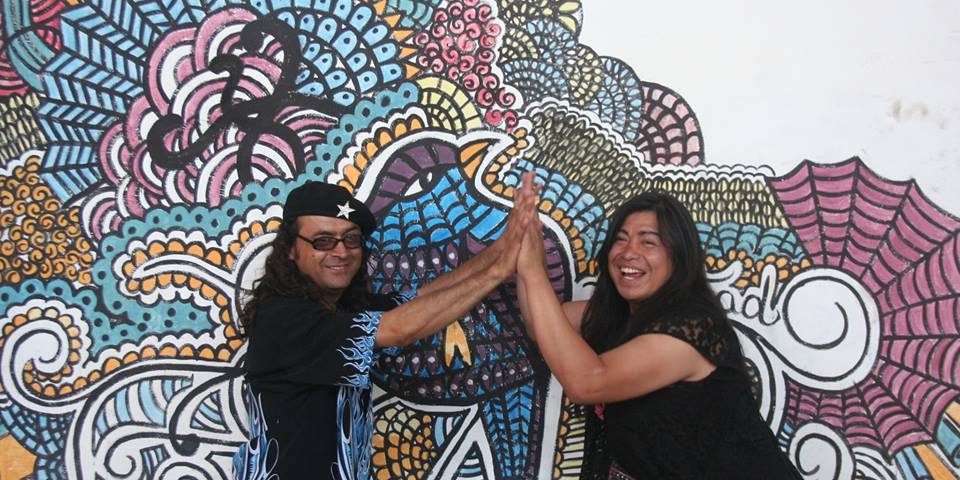
Diana and Victor Hugo Robles in Juchitán, Mexico.
– I learned your name and story of struggle through a very strong and striking international campaign that called for your release under the slogan “Free Diana”…
Yes, as soon as Willy is released (laughs). Until then, we were a group of people fighting against police repression, but when I was arrested in 2004, right after Kirchner's government took office, the police forces in power represented other interests. Imagine, this whole process in Argentina was just beginning. Because we had denounced police corruption and brothels, they fabricated a case against us, and my sister Yohana Sacayán and I were arrested. We were imprisoned for six months. While we were there, I dedicated myself more to reading because I had a lot of time, and I started writing and sending letters to the people who visited me: friends, union members, left-wing members of parliament, many people who were interested in us. Those were very hard months, and because of such a serious case, I couldn't just go anywhere because the police would transfer me at the first opportunity.
-Was the strong national and international campaign to free them important?
Yes, time eventually passed, and the organizations secured my release through a house arrest agreement. During that time, while under house arrest, I requested permission to study popular education at the University of the Mothers of Plaza de Mayo. I completed the program there, and it gave me the tools to systematize and analyze reality—something so significant for a population living in exclusion and marginalization. The majority of the trans population lacks access to texts, writing, and reading materials, which placed us in a particular position. In Argentina, 84% of trans women never completed secondary school, 74% did not finish primary school, and only 3% completed primary school. Therefore, the situation of exclusion is quite significant. Ninety-five percent rely on prostitution as their only means of survival, in addition to all the hardships that entails.
-What does prostitution mean?
– Prostitution is a form of social exploitation that severely damages self-esteem.
-Isn't that sex work?
-Absolutely not. I lived in prostitution for many years. I absolutely respect those who consider this their only means of survival, but we understand that this is a situation faced by the trans community because they are excluded from education, which consequently affects their access to employment, leaving prostitution as their only alternative.
-What to do then?
-We have to provide equal opportunities so that trans girls can go to school, play, and be happy, like any other girl or boy. Prostitution becomes a situation of marginalization. I'm talking about people who have to stand on a street corner offering their semi-naked bodies in freezing temperatures, surrounded by an environment where they have to endure police, street, social, and institutional violence. Many of them have to resort to numbing substances like drugs and alcohol. This whole context damages self-esteem. So, imagine this situation of exclusion, with self-esteem damaged in this way. How do you get this person out of that place so they can see the situation they're living in and analyze it? That takes a process, which is the biggest challenge: giving our trans sisters the tools to transform their reality. We can provide opportunities, build public policies from where we are, but it's important that these public policies have a recipient, that our sisters take ownership of the projects we create, because otherwise, who are we doing them for? For a group of people whose only place is prostitution, we are what the context around us says we are; society says we are born to prostitute ourselves and give pleasure. We can produce more than pleasure in exchange for money. We can produce discourses, we can produce public policies.
"I speak from the most radical transvestite community in Argentina"
– They can also create jobs, because one of the initiatives they're developing is to help girls finish their studies by creating educational programs and work cooperatives. Tell us about these interesting initiatives.
– We took as our starting point and turning point the introduction to the discussion about access to employment policies, or micro-enterprises, as you prefer to call them. The first experience came from the ALITT Association (Association for the Struggle for Transvestite and Transsexual Identity) together with Lohana Berkins, which is the launch of the Nadia Echazú Cooperative. Nadia was a trans activist murdered in Argentina, so this textile cooperative is the first cooperative financed by the State through the National Ministry of Labor and INADI (National Institute Against Discrimination, Xenophobia and Racism). This first initiative, to put it simply, "hit the nail on the head," having an impact on other organizations, like ours, which began to think about providing employment for our members, understanding that this first step was fundamental. We want and believe that these experiences must be replicated. Of course, what we want is genuine work, but for the moment these possibilities exist, so we began to work on these possibilities by establishing the Silvia Rivera Cooperative.
– I imagine it's in homage to the historic Puerto Rican activist…
Yes, Silvia Rivera was a Latin American activist living in the US who played a vital role in the Stonewall protests. To raise her banners, to reclaim her legacy in today's freelance , so people understand that these big parties happen because people died, because people fought, put their lives on the line, Silvia among them.
– A few years ago, Argentina made international news and a splash in the LGBT community due to the progress brought about by marriage equality. How did the trans community experience this victory?
– I don't speak for the trans community in general; I speak for the more radical, more politicized trans community in Argentina. We have, of course, taken a position in favor because we see it as an important foundation in terms of expanding rights, but we haven't played a participatory role in that process. First, because we weren't allowed to participate, and second, because we understood that marriage wasn't fundamental for us. Equal marriage in Argentina was the granting of a right framed within what is known as a liberal right, which is marriage. The Gender Identity Law and the abortion law are not civil rights; they are human rights laws because in these two situations, life is at stake. That is the great difference between the Equal Marriage Law and the Gender Identity and Abortion Laws. I speak about women's lives because the lives of thousands who try to get clandestine abortions and die along the way are at stake, along with the lives of trans people, for whom the second leading cause of death is the injection of industrial silicone. The Gender Identity Law establishes the right to health and the recognition of identity.

Diana Sacayán and Víctor Hugo Robles in Chile, 2012
– What would the recognition of that identity mean in the Gender Identity Law?
What this would mean is a fundamental step in claiming and accessing the rights granted in the National Constitution. In concrete terms, it would mean changing your name on the registry without having to undergo a psychiatric evaluation, without having to take medication, hormone therapy, or gender reassignment. If you want to do it, the State has to pay for it. This bill is progressive globally because, according to the Stop Pathologization campaign, it removes the pathological basis for our identity. It puts into practice a fundamental element: the Yogyakarta Principles . In practice, our identity will be recognized, but of course, it's not everything we wanted.
– What is missing?
You know that in all these processes we had to negotiate through the formation of a Gender Identity Law Front, made up of 18 organizations from across the country. From within, we've had a discussion about what our documents will say about our identities. The document will recognize us as men and women. In that sense, while acknowledging how advanced the project is, we can't help but point out that the project reproduces the parameters of binary thinking; it perpetuates a binary discourse. It's difficult for us to construct our own trans identity. I've suffered countless instances of discrimination and violence; that's the price, that's what it cost us.
– Isn't there institutional recognition of transvestite identity?
– No, there isn't full recognition, but there has been significant progress. The Supreme Court of Justice of Argentina, in a ruling, recognizes the existence of transvestite identity, along with various regulations and ministerial resolutions that recognize transvestite identity. They don't refer to women, they refer to transvestites. While the law is progressive, what it currently proposes is a binary concept: recognizing you as a man or a woman. Of course, we're going to see how we can improve that. We have to consider the context in which we formed as a Front to draft a Gender Identity Law in a context where hegemonic "gayness" was trying to impose a bill on us that represented the European perspective, the transsexual as all-encompassing. They wanted to put us through a filter of specialists who would say that we were who we claimed to be. We managed to overcome this attempt to impose this bill, forming this space that has not only made a parliamentary proposal, but has also managed to get that proposal introduced and has had the coherence and good sense to sit down and talk with other organizations such as ATTTA (Association of Transvestites, Transsexuals and Transgender People of Argentina), generating a more friendly climate to experience the process of the Gender Law.
– Was that climate positive among organizations that make differences?
– Yes, we have sat down, so much so that they are defending our bill.
– You'll soon be returning to Buenos Aires to continue your struggles and intense projects. What did you think of being in Chile and participating in the Communist Party's Hugs Festival?
– First, I deeply appreciate the outpouring of solidarity and affection from people here in Chile. Then, I value the political significance of being invited to this space to build a broader, more inclusive union proposal, encompassing a wider range of people, organizations, and expressions that were previously excluded from any possibility of unionization. Next, I appreciate the various opportunities I've had to participate, from talks to university events, right here at this University of Arts and Social Sciences ARCIS, which has opened its doors to foster debate and exchange on the history of the LGBTQ+ movement in Chile and allowed me to be part of this initiative. I've participated in other events and met some interesting people. In conclusion, this trip has served as a bridge to strengthen a necessary articulation in Latin America. It's necessary because we must build our own discourse, one that isn't the discourse imposed on us from a colonizing perspective, the one that seeks to impose policies from Europe through laws like the Equal Marriage Law or the half-baked Gender Identity Law.
Share
We are present
We are committed to journalism that delves into the territories and conducts thorough investigations, combined with new technologies and narrative formats. We want the protagonists, their stories, and their struggles to be present.
SUPPORT US

FOLLOW US
Related notes
We are present
This and other stories are not usually on the media agenda. Together we can bring them to light.