

#HIV in Chile: Lack of public campaigns denounced
Around World AIDS Day, Chile saw various events, public actions, and protests led by civil society organizations, particularly LGBTQ+ groups. A recent survey of young people and a study focused on the gay population highlight the lack of condoms and the need for public awareness campaigns…

Share

Around World AIDS Day, Chile saw various events, public actions, and protests led by civil society organizations, particularly LGBTQ+ groups. A recent survey of young people and a study focused on the gay population highlight the lack of condoms and the need for public prevention and information campaigns.
By @elchedelosgays , from Santiago, Chile
December 14th will mark 15 years since the publication in the Official Gazette of Law No. 19779, which "establishes regulations concerning the human immunodeficiency virus and creates a tax credit for catastrophic illnesses." Better known as the "AIDS Law," the legislation includes a National HIV Prevention Campaign that has yet to be implemented. It is estimated that there are 39,000 people living with HIV/AIDS in Chile today, of whom only 21,800 have been officially notified, representing 55% of those living with the virus. This means that 45% of people living with HIV in Chile are unaware of their status, are not using contraception, or are not protecting their sexual partners.
A study by the School of Public Health at the University of Chile reaffirms the difficulties men who have sex with men face in accessing prevention measures. “This highlights shortcomings in public prevention policies regarding HIV/AIDS and other sexually transmitted infections (STIs). Not only is there very low access to condoms, but access to testing also appears to be insufficient. Prevention programs are not reaching the populations that need them most,” Dr. Valeria Stuardo , Presentes .
“The fight against HIV has historically been waged from within communities; it is with them that prevention efforts must be strengthened. We need participatory and permanent public policies, policies that understand that prevention begins not only with condom use, but also with sex education, targeted community campaigns, a gender perspective, respect for human rights, cultural diversity, peer education, and dignified access to testing, among other things,” states a note published by the University of Chile.
The police broke up the protests
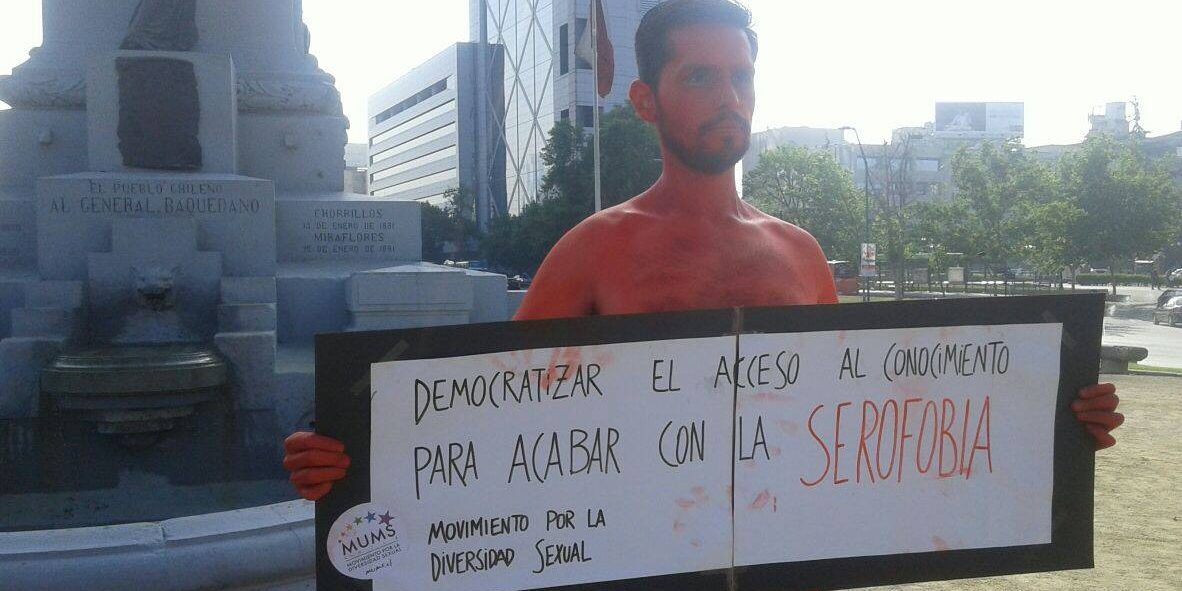
On December 1st, World AIDS Day, the HIV/AIDS Social Platform, an organization that brings together various Chilean social organizations, held a Citizen Prevention Fair in conjunction with government agencies interested in the issue. Similarly, various social organizations and LGBTQ+ movements carried out public demonstrations and actions demanding prevention campaigns. In particular, the Sexual Diversity Movement (MUMS), which disrobed in Plaza Italia—the epicenter of protests and sporting events in Santiago—demanding public policies, later arrived—naked and painted bright red—at the Citizen Prevention Fair. Their protest was applauded by those present but interrupted by the police, who reminded them of Article 373 of the Penal Code, which punishes “offenses against morality and good customs.”
“We left upset. Social organizations supported us, but the Chilean police insisted on removing us due to an alleged offense against morality. It doesn't seem like an offense against morality to prohibit sex education in schools and then lament the increase in the HIV transmission rate among young people,” Francisco Gutiérrez of MUMS Presentes

New gender categories among young people
In this context, the Savia Foundation, a community institution with more than 20 years of work, studies and political advocacy on sexuality and HIV/AIDS, published an analysis of the results of its survey applied between October and November 2016 to 842 young Chileans between 15 and 29 years old in five regions of the country, including the Libertador Bernardo O'Higgins, Biobío, Coquimbo, Valparaíso and Metropolitan Region.
Of the 842 respondents, 602 (71.5%) identified as heterosexual, 111 (13.2%) as homosexual, 74 (8.8%) as bisexual, 28 (3.3%) as lesbian, 4 (0.4%) as transgender, and, in a new finding, 20 (2.4%) classified themselves as "other ." "This last finding shows a new way of identifying oneself or of not wanting to be categorized. This represents a challenge to overcome or broaden the categories, as well as to allow people more freedom to identify themselves," the study states.
“It is important to emphasize that HIV prevention is a task for society as a whole, not only with a biomedical approach, but also incorporating emerging socio-cultural contributions that allow us to break down myths and prejudices, giving way to comprehensive knowledge about effective self-care,” he adds.
Among the data analyzed, it is relevant to highlight that 85% of young people reported being sexually active, of whom 50% stated that they do so regularly. When analyzing age in relation to the sexual activity reported by respondents, and sexual relations, it is observed that they have been sexually active since adolescence, with the frequency increasing with age before stabilizing. From age 16 onward, across all age ranges, the majority of respondents indicated that they were sexually active, either occasionally or regularly.
Similarly, young people mostly demand clear campaigns on HIV/AIDS prevention, recognizing the riskiest sexual practices, raising awareness and providing them with information regarding prevention, their sexual practices, and free access to supplies such as condoms.
93.1% of those interviewed indicated that correct condom use was an effective measure for HIV/AIDS prevention. The Savia Foundation asks: Where do young people get condoms? Is there free access?
“The voice of young people makes it essential that all public policies related to HIV/AIDS, particularly public prevention campaigns, incorporate their opinions and work based on them. Public policies must be constantly updated in accordance with the evolving nature of the epidemic and the changing culture, overcoming social stigmas and prejudices—a task for everyone,” reaffirms María Elena Ahumada of the Observatory of Public Policies and Human Rights on HIV/AIDS at Fundación Savia.
When the press talked about “gay cancer”
On December 14, in Antofagasta—one of the northern Chilean cities with the highest rates of HIV/AIDS notifications—the book “AIDS in Chile, Fragmented Histories” will be presented. It is a journalistic account of the response of organized civil society following the emergence of the pandemic in the country.
Published by Fundación Savia in co-edition with Siempreviva Ediciones, the book takes as its starting point the death of Edmundo Rodríguez Ramírez, a gay teacher from Maipú, who died of AIDS on August 22, 1984, shocking public opinion. “Rare disease,” “gay cancer,” was the uninformed reaction of the press at the time, unleashing alarm and social panic in the midst of Augusto Pinochet's civic-military dictatorship.
The unprecedented story reconstructs the first steps of community organizations that emerged as urgent and necessary responses to the pandemic, highlighting the pioneering and foundational work in the social history of Chile of the Chilean Corporation for the Prevention of AIDS (now Acciongay), the Support Center for People Living with HIV/AIDS and the National Coordinator of People Living with HIV/AIDS Vivopositivo.
Its main protagonists, men and women of struggle and cultural resistance, recount the political evolution of communities born to face death, discrimination and social stigma.
Follow us:
On Twitter
On Facebook
On Instagram
We are present
We are committed to journalism that delves into the territories and conducts thorough investigations, combined with new technologies and narrative formats. We want the protagonists, their stories, and their struggles to be present.
SUPPORT US

FOLLOW US
Related notes
We are present
This and other stories are not usually on the media agenda. Together we can bring them to light.