

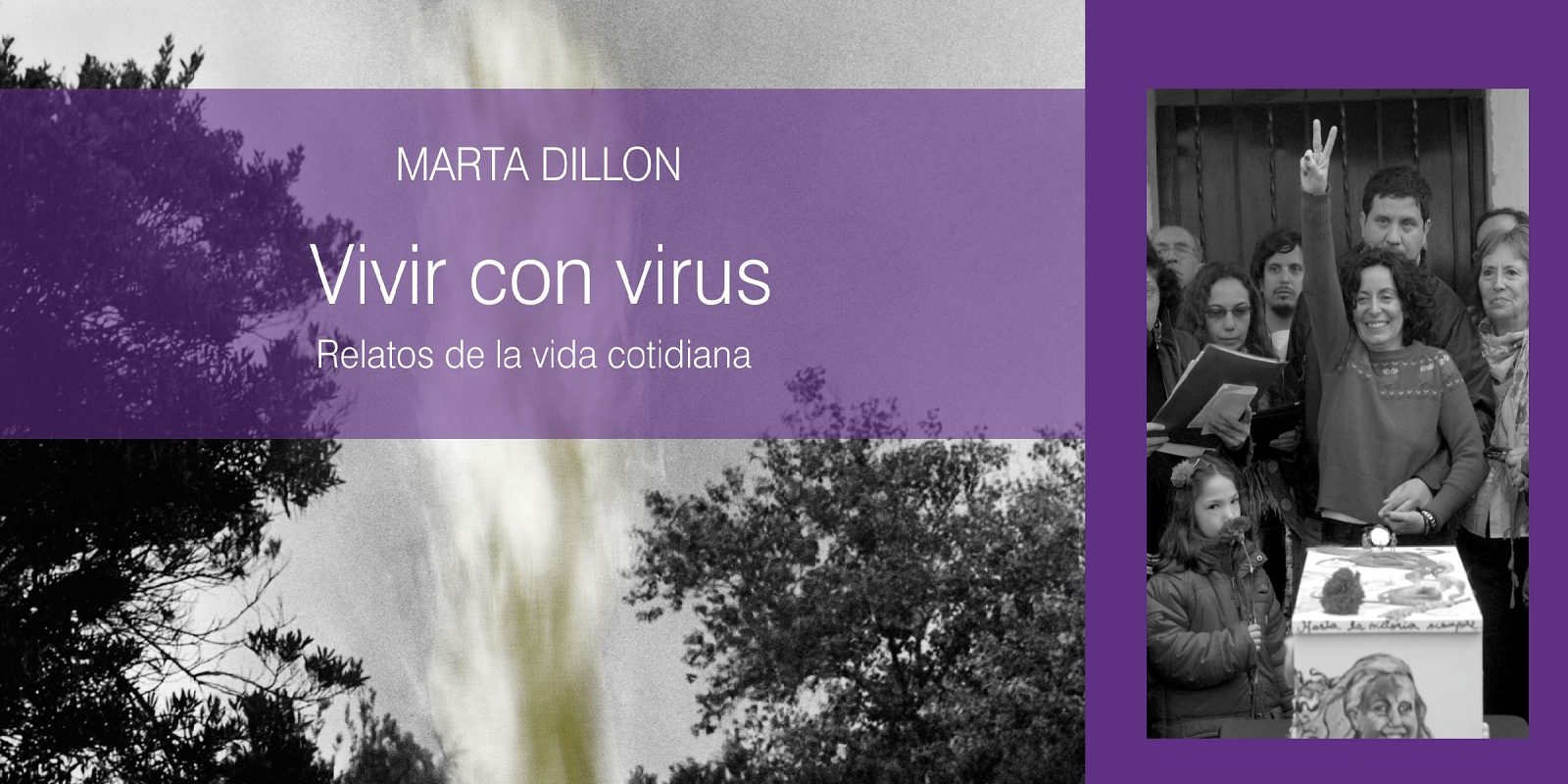
#Books: Living with Viruses, by Marta Dillon
For 10 years, her columns in the No supplement of the newspaper Página/12 revealed much more than a series of shimmering snapshots of living with HIV: her own stories and those of others, connections, farewells, clinics, fears, scars, and gems. It was the 1990s, and Marta Dillon's words opened spaces for debate, testimony, and support. On World AIDS Day, we republish…

Share

For ten years, her columns in the No supplement of the newspaper Página/12 revealed much more than a series of shimmering snapshots of living with HIV: her own stories and those of others, bonds, farewells, doctor's offices, fears, scars, and gems. It was the 1990s, and Marta Dillon's words opened spaces for debate, testimony, and support. On World AIDS Day, we reproduce excerpts from the book that compiles these texts, Living with Viruses, reissued in 2016 by the National University of La Plata Press (Edulp).
Prologue
This book began to be written more than twenty years ago. The final period of the text that follows was placed more than ten years ago. In between, the routine of writing the column every Sunday that would be published in the No supplement of the newspaper Página/12. An enormous tenderness envelops me as I see this web of words, which once saved my life, now put to paper. Tenderness for the person I was, for the naiveté that survives between the lines, for the commas and periods scattered throughout, for that convinced heterosexuality from which I fled with such pleasure. Everything is said in the pages that follow. I kept the prologue from the original 2004 edition, in honor of that succession of presents that weave together a life's journey. Many things have changed since then. We now know that HIV/AIDS treatments are truly effective, that the stigma has lessened while the threat of death has been postponed, and that condoms can even be dispensed with when the viral load remains undetectable. Other things remain the same: some bodies matter, others don't; those who die from HIV/AIDS-related causes are overwhelmingly poor, trans people, Indigenous people, Black people—the excluded. But I don't intend to talk about AIDS, even though that's where this story originates. This is a book about mourning and celebration. The recurring mourning that settles in every time the awareness of death appears, like a lightning bolt across the curtain of night. The celebration that illuminates this contrast, the intensity that comes from knowing that everything ends, everything passes, there is nothing more to it than being present. Now. I know, without any boasting, that this book has been a companion to many people. And each of them has helped me through the years, the loves and heartbreaks, the losses and the triumphs. Just as I learned that it's impossible to capture more than this fleeting heartbeat that right now calls my name, I also learned that there is no life for me outside the collective fabric, outside of friendship, affection, and recognition in the eyes of another. It is in community where I exist, resist, and love. Even though the constellations shift and their designs are sometimes traced over wounds. Pursuing dreams is as vital as being awake, right now, at this daily crossroads of time and space, flesh and bone, love and pain. Am I the same person who wrote what follows? How much have I transformed over the years? My body shows the passage of time, my desire detaches itself from the linearity imposed by counting the years one by one. The desire remains intact, the thirst for poetry, the body—this one I have with all its marks, its wrinkles, its strengths and weaknesses; All of that is in place. That hasn't changed, and that's why I'm writing this new edition, to offer the innocence of my youth now that I'm no longer young. Because I know that the gem I discovered one day is still there, shining. It's that fire on the cover, the fire we keep in our hearts. The warmth that propels us each day, to one more day. And another, and another. Marta Dillon, March 2016
January-July 1996
I like to think that for me, having HIV was like hearing an alarm clock. Too many images flooded my mind to let the news pass unnoticed. I emerged from the lethargy of an anesthetized life. I began to be aware of each of my steps, my affections, my possibilities. But staying awake is, at times, exhausting work. Some days hunger consumes me, and I stride forward. Mounted on seven-league boots, I spend days busy with different things, swept away by the desire to leave my mark. Others, I simply isolate myself in my corner and can do nothing but stare at the sky. The unchanging. The sun, the clouds, the rain. In this ebb and flow of the sea, my desire is cradled. A rhythm of waves that sometimes overwhelms me. Spills. And after the breaking surf, it carries away my ephemeral enthusiasms like objects swept away by the flood. But awake as I am, I know I cannot lament what I don't have. I am obliged to also confront the loss. It is in the silence that I best hear my heartbeat. The certainty of what remains unchanged illuminates me once more. The sky there, watching me. The cold and the heat. The single rose in the garden in winter. The embrace of one who doesn't invest but gives. That pulse is the only constant in this coming and going: I am alive. And I have no other loyalty.July-December 1996
I go to the hospital after two months. It's a cool morning, I have no bad news to share, I've gained weight, and there are no problems with my treatment. Dr. Losso is in his usual good, moderate mood. While he writes the orders for the tests that my health insurance doesn't yet cover, we talk about the lack of medication. He can't help but tell me about the negligence surrounding the cases, the botched bidding processes, the Ministry's inaction. "And what about the people?" I ask, somewhat incredulous. He, used to hiding his helplessness, replies: "If they don't have health insurance, they die." They get on the packed bus and exchange a few words with the driver. One of them is carrying a baby. Both are over 30, well-dressed, and speak clearly. They tell the passengers that they have HIV, that they don't intend to beg, but that they are forced to ask for help to cover treatments they had to stop because the hospital no longer provides the necessary medications to control the virus. Everyone pitches in; some people even give up to ten pesos. There's no shame on their faces, just a firm determination not to give up. When they get out of the car, a boy no more than six years old asks them for a coin to buy a hot dog. It's three in the afternoon and he hasn't eaten in a day.1998-2000
I'm reading the newspaper, I reach into my purse, take out my glasses case, and a miracle occurs: sand. A handful of sand I brought from paradise, and here, far from distant beaches, it's a shimmering treasure. This sand brings me a clear horizon, the caress of the sea, a time without urgency, a time that flows and lets me sway on the waves, on events, on life. I stop again before its presence, in this strange place, with its daily misery, with its carrot dangling in front of my nose, making me run like a donkey with blinders. Where am I going? I drift through the week in search of its end, I drink in leisure with desperation, and I blame myself constantly for not doing what I should be doing, for not writing the great works I fantasize I could, for not seeing all the films, plays, and exhibitions that are supposed to nourish the soul, but which force me to rush, once again, from one place to another, so as not to miss information, stimulation, exchange, who knows what else. Pleasure is elusive when we chase after it. What does it mean to do the right thing? Sometimes I dream of staying home, waiting for my daughter to come home from school, going through her notebooks, doing homework together. And what would we live on then? And what is fulfillment all about? How can I think about health when I can barely think about what I'm going to eat tonight? And when am I going to prepare it, and when am I going to read until I'm exhausted, and when am I going to take the time to write without urgency, without deadlines, without thinking about money? I know; I know these are pointless complaints. Right now, I hold in my hands a treasure of sand that takes me back to the beach, to the infinite horizon, to a time without urgency that caresses me like the waves, that gives me strength, that comforts me. Martín doesn't go to the doctor because he's afraid they'll tell him something he doesn't want to hear. He feels unwell quite often, he feels weak. At night he wakes up suddenly, as if his bed had been shaken, and his eyes widen. Every now and then he looks in the mirror and thinks he's discovering a blemish or that his hair is falling out too much, or he feels an uncomfortable swelling where the lymph nodes are supposed to be. But no, he doesn't want to go to the doctor. "Maybe what you have is nothing serious, if you even have anything," I tell him. "Well, if it's nothing serious, it'll pass," he replies. He prefers not to know. Martín is one of those people who believes that if he closes his eyes, no one can see him. That if he closes his eyes tightly, the truth will pass him by.2001 onwards
“Mom, who did you catch it from?” What a question to throw into a quiet dinner, any night now, between corn on the cob and steamed potatoes, our favorite meal. A favorite meal that immediately ended up stuck between my throat and the table. “What do you mean, from whom?” I asked in a vain attempt to give my questions some time to sort themselves out. It wasn't very helpful, and it was obvious why. I wasn't going to invent a story about open wounds for my daughter just to beat around the bush. I never bitten myself; I obviously got infected during sex where I didn't use a condom, which I may or may not have identified, but it's certainly irrelevant. How or when I got infected is the million-dollar question, the one that generates the most curiosity, and I always answer the same thing: I don't know, what does it matter? In any case, I got infected because I didn't take precautions to avoid it, because at that time some of us subscribed to strange theories about the virus not existing—a theory that continues to spread on the internet and about which I constantly receive various complaints—maybe because it wasn't yet a problem for women, maybe because I'm an idiot. I didn't convince her. "What, don't you know who you were with?" Yikes. Yes, of course I know who I was with, maybe one night slips my mind, as the years go by a few more slip away, but it's not like I'm overreacting. Not answering for me was always an ethical matter; when they asked me, I sensed on the other side a certain need to be reassured, to find some way to avoid being considered a possibility. Or to hear the story of some surgical accident so I wouldn't have to condemn myself to the hell that promiscuous people deserve. But telling my daughter I don't know isn't a reassuring answer. Nor is telling her that I got infected while in a relationship, a stable relationship as is still recommended as an effective form of protection. It's an exemplary answer I often give in public, since I'm part of the statistics that show how much the epidemic has grown among women. I opted for the unreassuring answer; I have no choice but to take responsibility. I got infected sometime between such and such a date, I told her, and mainly because I didn't use a condom during all my sexual encounters. All grief brings one certainty: the gentle hand of time that comforts them. In retrospect, the worst nightmares seem like nothing more than puppets dancing behind a fogged-up window, and although it's always difficult to walk the corridors of loss, time teaches that there's no possibility of getting trapped in that labyrinth. Because the current's course is inexorable, and there's nothing left to do but navigate it. Adrift, perhaps, or holding the helm, but always in motion. As long as I can decide, I'll search for my path. I can't find enough reason to swallow water until I drown. When the violence of the fall touches me, I let myself go; there's no point in resisting, just wait until the calm arrives and then start stirring the waves. The body has its own language to express loss and attends to its other griefs. Even when I don't understand its images, even when they are so far removed from the images I reconstruct far from the mirror, there is still a dynamic between what I see and what I want, what I know and what I imagine. And in those intervals lies my identity. Time has erased its trace from my skin. Like sand on a wet body, that's what its memory was like. And it fell away with the sun. The scars hurt like broken bones of old, on humid days. What remains in my hands of all that I had? Yes, experience. And a touch, like a magic wand, that once told me I was chosen. Nothing more. I am someone else, it's true. And at the same time, the same. The same undiminished conviction that sailing is essential remains, and now I'm more certain of where I want to steer my ship. I also know that small losses won't kill me, and that I would do it all again without a moment's hesitation. I might adjust my course this way or that, but I have no regrets. I've always been ready for whatever comes, just as I'm ready to die when the time comes. And what will it be like? Will it hurt? These texts are part of the book Living with Viruses, 2016 reissue, Editorial de la Universidad Nacional de La Plata (Edulp) .Follow us:
In Twitter In Facebook In Instagram]]>Share
We are present
We are committed to journalism that delves into the territories and conducts thorough investigations, combined with new technologies and narrative formats. We want the protagonists, their stories, and their struggles to be present.
SUPPORT US

FOLLOW US
Related notes


We are present
This and other stories are not usually on the media agenda. Together we can bring them to light.